Opting out, then back in: How patent owners are quietly reshaping UPC enforcement strategy


When the Unified Patent Court (UPC) launched in June 2023, one of the most consequential decisions facing European patent (EP) owners was whether to opt out of the court’s jurisdiction. For many, the choice was driven by a major, existential concern: the risk of central revocation.
Recently, the strategy on the initially opted-out EP patents has been evolving.
A significant number of patent holders are opting out early and later withdrawing that opt-out to bring infringement actions before the UPC on their own timing. This two-step approach, once speculative, is now visible in the data. And it offers important clues about how sophisticated rights holders are learning to manage risk, enforcement leverage and forum choice under the UPC framework.
The legal backdrop: Concurrent jurisdiction during the transitional period
In principle, both Unitary Patents and traditional European patents fall within the jurisdiction of the UPC. However, The Agreement on a Unified Patent Court (UPCA) provides for a seven-year transitional period during which national courts retain jurisdiction over infringement and revocation actions concerning European patents.
During this period, the UPC and national courts exercise concurrent jurisdiction over EP patents. Patent owners may choose where to enforce their rights, and third parties may choose where to challenge them.
To mitigate exposure to the UPC’s central revocation mechanism, many proprietors opted to exclude their EP patents from UPC jurisdiction altogether. An opt-out removes the patent from the UPC system and leaves jurisdiction solely with national courts.
The rationale is clear: a single revocation action before the UPC, whether in the Central Division or as a counterclaim before a Local Division, can knock out a patent across all participating states (18 at the time of writing). For valuable or vulnerable portfolios, that risk concentration is material.
Opt-in is possible, but only once
Crucially, an opt-out is not permanent.
Provided no national court action has already been initiated for the patent or related Supplementary Protection Certificate (SPC), the opt-out can be withdrawn at any time, even after the end of the transitional period. This withdrawal is commonly referred to as an ‘opt-in’.
But there is a catch: the opt-in is irrevocable. Once UPC jurisdiction is restored, the patent is exposed again to central revocation risk.
That asymmetry has opened the door to a deliberate sequencing strategy:
- Opt-out early to neutralize central revocation risk.
- Monitor the competitive landscape.
- Opt back in when UPC enforcement becomes strategically attractive.
The two-step strategy in practice
Data from Derwent Patent Search and Dartsip shows that this opt-out then opt-in strategy is no longer theoretical.
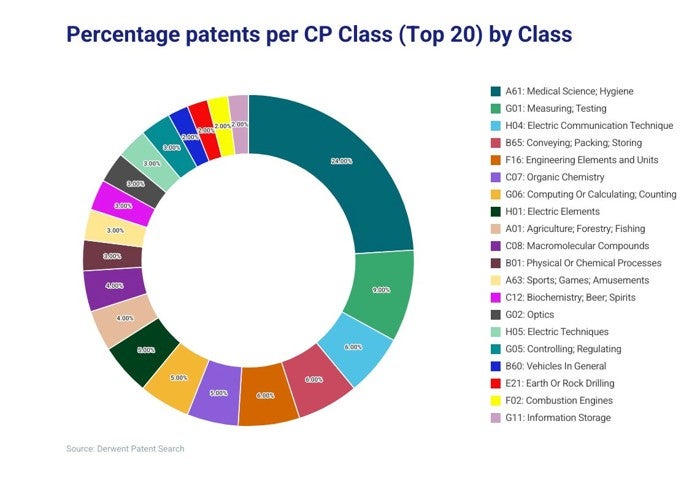
Figure 1: Distribution of Top 20 IPC classes for EP patents that were the subject of the two-step strategy – opt-out followed by opt-in. This Top 20 corresponds to 3903 EP patents, while there were 6011 (as of January 20th) EP patents that were the subject of the two-step strategy — opt-out followed by opt-in.
It is being used at scale, and disproportionately in certain technical fields.
The highest concentration of patents following this two-step path appears in:
- Drugs and medical devices (IPC A61)
- Measuring and testing technologies (G01)
- Electric communication technologies (H04)
- Conveying, packing and storing (B65)
- Engineering elements (F16)
- Organic chemistry (C07)
In the drugs and medical devices sector alone, nearly one thousand patents that were initially opted out have now had their opt-out withdrawn.
These are not marginal assets. They sit in sectors where enforcement stakes are high, competitive intelligence is critical and timing can be decisive.
From opt‑in to infringement: A narrow window
What happens after opt-in is equally telling.
To date, 16 UPC infringement actions have been brought on patents that followed this two-step strategy (through January 31, 2025). The timing is striking:
- Average delay from opt-in to infringement action: approximately 4 months
- Shortest delay: 1 week
- Longest delay: roughly 13.5 months
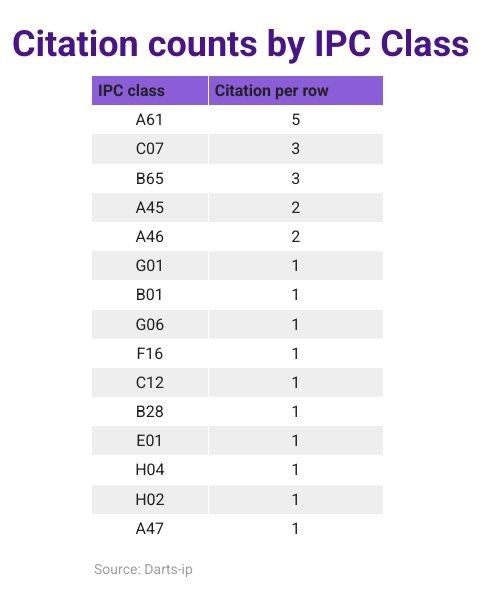
Figure 2: Number of citations of each IPC class corresponding to 16 infringement cases* brought before the UPC (up to January 31st, 2026). The EP patents at issue in these 16 cases were the subject of the two-step strategy: opt-out followed by opt-in.
*Note: The total number of IPC class citations (25) exceeds the number of cases (16), as individual cases may involve multiple patents, and patents may be classified across multiple IPC classes.
In other words, opt‑in is rarely speculative. In most cases, it appears to be a prelude to imminent enforcement, not a tentative experiment.
The technical profile of these cases mirrors the broader opt‑in pattern. Among the most represented fields in these 16 proceedings are:
- Drugs and medical devices (A61)
- Organic chemistry (C07)
- Conveying, packing and storing (B65)
These are sectors where cross-border remedies, procedural speed and centralized enforcement can outweigh the residual revocation risk, particularly once freedom to operate (FTO) positions and validity confidence have been reassessed.
Life sciences and medical device portfolios are particularly well-suited to this sequencing. Patents in these sectors often protect products with long development cycles and highly predictable commercialization timelines. That allows rights holders to opt out early, limit exposure while competitive and regulatory landscapes stabilize and then reenter UPC jurisdiction once enforcement objectives and risk tolerance are clearer. In that sense, opt-in is less a procedural reversal than a signal that the patent has moved from a defensive posture to active use.
Patent strategy at the UPC
Several strategic signals emerge from this behavior.
First, patent owners are no longer treating opt-out as permanent. It is increasingly viewed as a reversible risk management tool that can be aligned with business timing.
Second, opt-in is functioning as an enforcement signal. Once a previously opted-out patent moves back under UPC jurisdiction, the probability of near-term litigation rises sharply.
Third, technology matters. The fields most associated with this strategy tend to involve:
- High development costs
- Regulatory barriers
- Complex validity landscapes
- Significant cross‑border exposure
These characteristics make the UPC’s territorial reach attractive, but only once the enforcement calculus turns favorable.
Why monitoring opt-in activity now matters
For defendants and FTO teams, this trend has a practical implication: opt-in activity (6011 EP patents as of January 20th 2026) deserves the same attention as new filings or PI requests.
A withdrawn opt-out can be an early warning:
- That enforcement is being prepared
- That risk tolerance has shifted
- That forum strategy has been finalized.
In sectors such as life sciences, chemistry and advanced manufacturing, failure to track these changes in jurisdictional status could mean missing the narrow window between opt-in and suit.
A maturing enforcement playbook
The ‘opt-out then opt-in’ strategy reflects a broader truth about the UPC: it is no longer being used experimentally. It is being integrated into deliberate, portfolio-level enforcement planning.
For both sides of the dispute, understanding when patents move back into UPC jurisdiction may soon be as important as knowing where actions are filed.
Methodology
This analysis is based on opt-out and opt-in status data from Derwent Patent Search and UPC infringement proceedings data from Darts-ip, covering activity up to January 31, 2026. Figures reflect observed cases (as of January 20th) and may evolve as additional proceedings are filed.
About the authors
Eric Sergheraert
Eric is a Doctor of Pharmacy (PharmD) and a Doctor of Law (Phd) and holds the certificate of aptitude for the profession of lawyer (CAPA) and a Diploma in Patents from CEIPI (the Centre for International Intellectual Property Studies in Strasbourg). He has 27 years of experience in the intellectual property profession and has worked in the IP service of the Macopharma Pharmaceutical Laboratory, the firm EGYP (IP consultants) and the law firm Véron & Associés. He is Professor at the University of Lille (France) and Director, Product Consulting, Clarivate.
Neşe Günal is a Senior Manager at Clarivate, coordinating a global team working on legal content analysis, observing patent prosecution and litigation trends worldwide, and managing the patent-related curation projects for Darts-ip. She holds a Master of Intellectual Property and ICT Law (cum laude) from KU Leuven.
Read earlier blogs in our series


Related insights
The latest news, technologies, and resources from our team.