
For decades, trademark representation has been strongly shaped by territory. Local rules, examination culture and risk profiles all reinforce the idea that filings are best handled by firms, rooted in their respective jurisdictions. The latest trademark filing data tells a more complicated story.
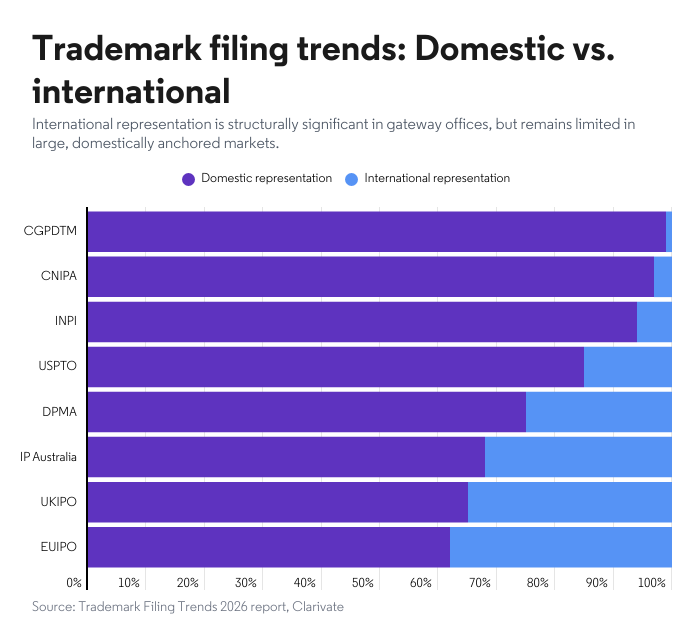
Across more than half of the jurisdictions analyzed in the Trademark Filing Trends 2026 report, international representatives account for a substantial share of filings. In several regions, it marks a clear departure from the fully localized representation patterns that characterized the register only a year earlier.
For experienced practitioners, this raises a harder question than simply who is filing where. It asks whether the gravity of trademark practice is starting to move away from national offices and toward cross-border systems and workflows.
In this blog, we look at what the 2025 filing data reveals about how representation models are changing across key trademark jurisdictions. We also take a deeper look into why representation model changes are occurring now and what they suggest about how risk, speed and scale are being balanced in modern trademark portfolios. We examine the implications for experienced trademark lawyers and senior IP teams advising on portfolio structure, representative oversight and long-term brand protection as filing workflows become more internationally coordinated.
What the data is really showing about international representation
At first glance, increased international representation might be read as a natural response to globalized brand activity. Multinational businesses file broadly, so multinational service providers step in. But that explanation undersells what is visible in the data.
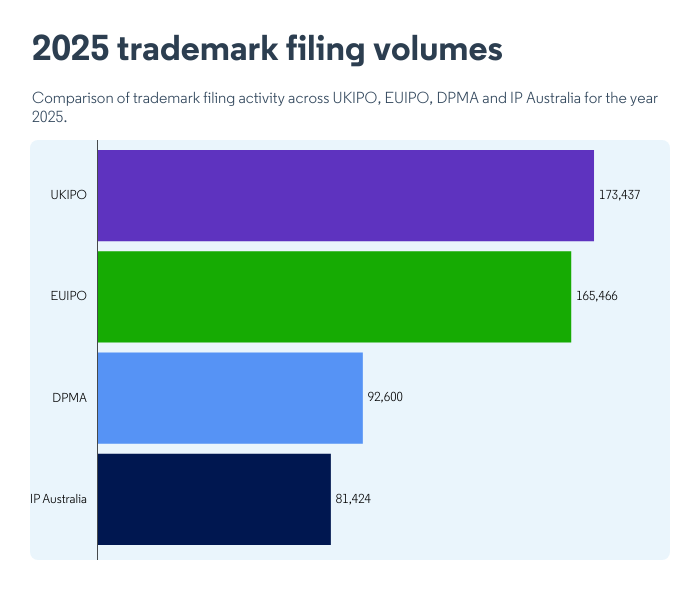
This is not just a question about global brand owners consolidating counsel. The representative tables show scaled activity by a relatively small group of providers, specifically those of the European Union (EUIPO), the United Kingdom (UKIPO), Germany (DPMA) and Australia (IP Australia). These representatives are managing extremely high filing volumes across multiple registers, often at levels that rival or exceed established domestic firms.
This shift may indicate that clients are prioritizing efficiency over local representation. Many of the international representatives appearing repeatedly across jurisdictions are built around standardized, high-throughput filing processes rather than bespoke jurisdiction-specific advice.
Why filing behavior may be shifting toward speed and coordination
How are trademark filings increasingly integrated into broader commercial and operational considerations? In some contexts, evidence of a trademark filing may be sufficient to enable downstream activity, such as marketplace participation or brand activation, even before examination outcomes are known. In these environments , filing behavior may naturally prioritize speed, procedural completion and coverage over jurisdiction‑specific assessment at the outset.
While the Trademark Filing Trends 2026 report does not attribute filing patterns to any single platform or mechanism, the data is consistent with environments in which filing serves as an operational prerequisite rather than solely as a long‑term enforcement tool.
This perspective helps explain why certain jurisdictions and sectors show stronger shifts toward internationally coordinated representation without suggesting any erosion of legal standards or value.
How this sits alongside traditional law firm models
The data also invites reflection on how these filing patterns coexist with established models of cross‑border legal practice.
For many years, international expansion for law firms has centered on building physical presence across multiple jurisdictions to support local advice, client relationships and complex matters. That model continues to play an essential role, particularly where regulatory nuance, enforcement and dispute strategy are involved.
What appears to be emerging in certain gateway jurisdictions is client demand for highly coordinated, process‑driven execution alongside traditional advisory work. In companies with portfolios that require filing at scale, particularly in growing sectors, decision‑makers may be looking for service models that emphasize simplicity and ease of coordination across markets.
While the data itself does not explain how clients select between these options, it raises thoughtful points for reflection:
- Are some filing decisions increasingly influenced by how easily services can be accessed, coordinated and managed across multiple jurisdictions rather than by geographic presence alone?
- Are operational considerations such as standardized workflows, turnaround times and portfolio visibility playing a more prominent role at the filing stage, while local legal expertise is reserved for enforcement, disputes and higher‑risk strategic decisions?
Seen through this lens, the growth of international representation does not signal a departure from traditional law firm value. Rather, it suggests a more differentiated ecosystem, where different models support different phases of the trademark lifecycle. Filing execution, portfolio oversight and legal strategy may increasingly be delivered through complementary approaches, each optimized for distinct needs.
Why some jurisdictions remain predominantly domestic
The contrast with markets such as the United States, France, India and Mainland China reinforces this interpretation. In those jurisdictions, representation remains predominantly domestic, reflecting the continued importance of local market depth, regulatory specificity and nationally anchored filing behavior.
No single model is universally preferred. Instead, representation choices appear closely aligned with how brands structure their portfolios and where scale and coordination deliver the greatest benefit.
How scale and efficiency reshape where risk is managed
Internationalized representation does not eliminate local risk. Rather, it redistributes the points at which risk is identified, escalated and managed within the workflow.
When filings are coordinated across multiple jurisdictions by a centralized provider, strategic decisions about clearance thresholds, classification breadth and enforcement posture tend to be made earlier and at a more abstract level. That can work well for high-volume, short-cycle branding strategies, particularly those tied to e-commerce or fast product iteration. It is less obviously aligned with marks that carry long-term reputational or regulatory exposure.
The data shows that many of the filings driving international representative volumes come from sectors including apparel and footwear, consumer goods and retail, where portfolios are scaled quickly and coverage density is a commercial priority. This does not make the approach wrong, but it does change where judgment sits in the system.
For in‑house teams, this reflects a structural change. Centralized filing models offer clear advantages in consistency, cost predictability and cross‑market visibility, particularly for portfolios spanning multiple jurisdictions. In the data, this pattern is most visible in filings at scale through gateway offices such as the EUIPO, the UKIPO and IP Australia. . As filing activity becomes more globally coordinated, the role of local expertise does not diminish. Instead, it is applied more selectively, with judgment surfaced through oversight, escalation and enforcement decisions rather than at the point of routine filing.
For law firms, the data points to a rebalancing of where different types of value are delivered. Local firms continue to play a critical role in disputes, enforcement and high‑stakes portfolio decisions, particularly in jurisdictions where domestic representation remains the norm. At the same time, the report shows that routine filing activity in some regions is increasingly handled through international, high‑throughput models. This reflects a broader separation between scaled portfolio execution and jurisdiction‑specific advisory work, allowing firms to focus their expertise where local knowledge has the greatest strategic impact.
What international representation signals about future portfolio strategy
Perhaps the most revealing aspect of this trend is the question it raises: what does the rise of internationalized representation tell us about how trademark portfolios are being structured going forward?
International representative dominance is most pronounced in jurisdictions that function as gateways. The EUIPO, UKIPO and IP Australia sit at the intersection of regional coverage and global commerce. Filing behavior there increasingly reflects portfolio architecture decisions rather than isolated national protection. Brands appear to be treating these offices as strategic nodes rather than endpoints.
That has downstream effects. As portfolios become more structurally coordinated across regions, the distinction between filing strategy and enforcement strategy tightens. Clearance risk in one jurisdiction can no longer be evaluated in isolation if the same representative is driving parallel filings elsewhere. Similarly, enforcement decisions may become more standardized, for better or worse, as portfolios scale.
None of this suggests that localization is disappearing. The data shows very clearly that it persists where domestic markets are large, regulation is distinctive or filing volumes are primarily national. Instead, what is emerging is a bifurcated system: deeply local in some jurisdictions, distinctly international in others, with different risk profiles attached to each.
What experienced practitioners need to know
For trademark lawyers and senior IP professionals, the takeaway is not to choose between local and international representation. It is to recognize that representation itself is now a strategic variable.
Questions that would once have been operational are becoming strategic. Where is filing judgment being centralized? How much discretion does a representative have across jurisdictions? What assumptions are embedded in standardized filing workflows? And critically, where does liability sit when a cross-border filing strategy encounters local resistance?
The data does not suggest that internationalized representation is inherently riskier. It does suggest that it requires a different kind of oversight. As filing volumes concentrate among fewer, more international providers, the cost of systemic error increases even as the cost of individual filings declines.
The full report matters
This blog isolates one signal, but it does not stand alone. The Trademark Filing Trends 2026 report places representative internationalization alongside filing volumes, sector concentration and jurisdictional divergence across ten major trademark registers. For anyone advising on trademark strategy, those connections matter.
Reading the full report provides the broader context needed to assess whether this shift reflects temporary market conditions or a more durable reconfiguration of trademark practice. It allows practitioners to test their assumptions against multi-jurisdiction data and to understand how representative behavior intersects with industry, geography and portfolio design.
In a system that is becoming more globally coordinated by the year, that perspective is no longer optional.
Access the full report and explore the data shaping global trademark strategy.


Related insights
The latest news, technologies, and resources from our team.