Who wins at the Unified Patent Court? Clear signals from two years of decisions


As we’re coming to this last part of the blog analyzing the first two years of UPC infringement cases, enough decisions on the merits have accumulated to reveal meaningful patterns in how local divisions decide infringement and validity. Leveraging Darts-ip litigation data for decisions that occurred in 2024 and 2025 (through May 31), we see that across the court, patentees win 54.2% of the time. However, what this overall statistic masks at first glance are substantial differences between divisions in both outcomes and speed.
In this final post of our UPC Year-Two analytics series, we break down the win rates, dig into division-level behavior, and highlight what this means for UPC strategy going forward.
Read the first two blogs in the ‘UPC at two’ series
- Preliminary injunctions at the UPC: Speed, success and strategy
- What’s being litigated: Technology trends at the UPC
Patentee win rates: Stable overall, but with big swings by division
Across the 36 merits decisions issued in the UPC’s first two years, patentees prevailed in 54.2% of cases, an outcome that remained relatively steady year to year (57.9% from June 2023 to May 2024 vs. 52.4% from June 2024 to May 2025).
But the topline number obscures a striking split among the most active divisions. Munich has the highest win rate of 71.4%, followed by Düsseldorf at 60.0%, then Mannheim at 50%, and Paris with the lowest rate of 33.4%.
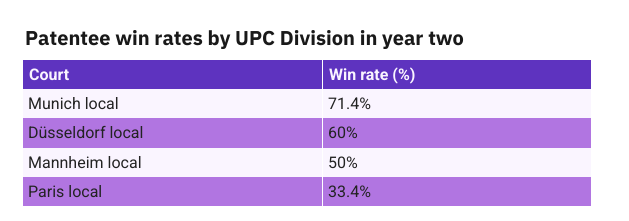
Figure 1: Patentee win rates by UPC division in year two
Why are outcomes so different?
If we dig a little deeper, two notable patterns emerge from this UPC litigation data. In Munich, Mannheim, and Paris, every loss for the patentee resulted from the patent being revoked, meaning infringement was never assessed. In Düsseldorf, losses were split: 20% were revoked, and 20% were maintained but not infringed.
The data reveals an important takeaway for patentees – the risk of revocation is not uniform across the UPC.
Speed matters: Paris is the fastest path to a merits decision
Examining the win rate data, we also see that not all divisions move at the same pace. Median duration to a merits decision shows a spread of nearly three months between the fastest and slowest divisions. Paris is the fastest division on merits, though it delivers the lowest win rate. Mannheim, while balanced in outcomes, is the slowest.
This speed variation can meaningfully shape enforcement timelines, injunction pressure, and portfolio-level strategy for plaintiffs.
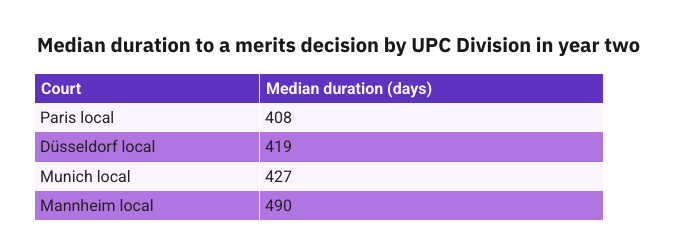
Figure 2: Median duration to merits decision by UPC division in year two
Putting it all together: Strategy implications going into year three
Across the first two years of the UPC, a number of data-driven patterns stand out, and together, they offer a clearer blueprint for how patentees and defendants might approach UPC litigation. Overall takeaways from the data are as follows:
- Forum selection matters more than ever.
With patentee win rates ranging from 71.4% in Munich to 33.4% in Paris, forum choice can meaningfully shift risk. For patentees, Munich currently presents the most favorable merits landscape. For defendants, Paris and Mannheim offer comparatively lower patentee success rates.
- Insights from preliminary injunction outcomes show meaningful differences across divisions:
- Need speed? The Hague is the fastest division for preliminary injunctions (median 91 days – 52 days shorter than the longest).
- Need a higher likelihood of grant? Munich has the strongest preliminary injunction grant rate profile by far (55,6% granted).
Aligning PI and merits strategy early, especially around urgency, risk tolerance, and forum dynamics, can materially change the trajectory of a case.
- Consider the technology mix when assessing risk.
Digital communication, medical technology, and telecom dominate UPC infringement activity. These sectors tend to see more complex, higher-value disputes, often with aggressive PI behavior. Understanding how your technology fits into the UPC ecosystem helps forecast adversary behavior, speed, and division expertise.
- Adjust timing expectations to reflect real UPC durations.
Merits decisions take 408–490 days, depending on division. Besides the fact that UPC, merits timelines are quite efficient, this data reveals meaningful differences across divisions.
- Litigation data can be a strategic differentiator.
Litigants with access to high-quality UPC analytics on filings, technologies, preliminary injunction outcomes, merits decisions, durations, and revocation patterns will be better positioned to:
- pick the right division
- anticipate strategy
- adjust expectations on duration and risk
- time enforcement actions more effectively
Read more about Darts-ip litigation intelligence.
Methodology
This analysis covers UPC litigation decisions from June 1, 2023, to May 31, 2025, using data from the Darts-Ip patent litigation database. This analysis is subject to change as case law evolves.
About the authors
Eric Sergheraert
Eric is a Doctor of Pharmacy (PharmD) and a Doctor of Law (Phd) and holds the certificate of aptitude for the profession of lawyer (CAPA) and a Diploma in Patents from CEIPI (the Centre for International Intellectual Property Studies in Strasbourg). He has 27 years of experience in the intellectual property profession and has worked in the IP service of the Macopharma Pharmaceutical Laboratory, the firm EGYP (IP consultants) and the law firm Véron & Associés. He is Professor at the University of Lille (France) and Director, Litigation content strategy for the international IP case law database Darts ip, part of Clarivate.
Neşe Günal is a Senior Manager at Clarivate, coordinating a global team working on legal content analysis, observing patent prosecution and litigation trends worldwide, and managing the patent-related curation projects for Darts-ip. She holds a Master of Intellectual Property and ICT Law (cum laude) from KU Leuven.


Related insights
The latest news, technologies, and resources from our team.