

By the time a new company reveals its name, the choices that shaped it have largely disappeared from view.
The public sees one word on a website, above office entrances or at the bottom of an email. It looks settled. Perhaps even inevitable.
CLARIVATE was anything but inevitable.
Ten years ago, I found myself working on a trademark-clearance project in which the client was, in effect, my own company.
The business, then known as Thomson Reuters IP & Science, was preparing to become independent. It needed a new name, and the deadline was set by the transaction. The new company would operate in more than 100 countries, across multiple goods and services classes. Whatever name was selected had to be ready for international use from Day 1.
For a trademark professional, this was an unusual brief. It was also a familiar problem on a much larger scale: many people had ideas, the business had a fixed date and no candidate mattered unless the evidence supported its use.
I suspect many trademark professionals will recognize what happened next. A candidate begins to attract internal support before the search position is complete. Each additional market produces another question. The domain, filing strategy, and intended use all need attention, yet the commercial timetable continues to advance.
That is when good search support becomes most valuable. The task is not merely to return results. It is to help the business understand which questions could still change the decision, where deeper work is justified, and when the evidence is strong enough to proceed.
The name that eventually emerged was CLARIVATE.
Ten years of use have made that choice look natural. The work required to reach it was anything but.
“The legal and financial ownership of IP & Science has transferred from Thomson Reuters to Onex and Baring Asia and we are now called Clarivate Analytics. 3 October, 2016 is Day 1 of our new company.”
From the original Day 1 communication announcing Clarivate Analytics, October 3, 2016.
A global company without a name
The certainty of the launch announcement concealed the problem that preceded it. At the beginning of the exercise, the new company had no name and only a compressed period in which to create, clear and prepare one for launch.
Starting without an inherited identity offered considerable creative freedom. The business could choose a name that reflected what it intended to become. That freedom came with exacting constraints. The name had to be distinctive, easy to read and write and broad enough to represent a business spanning intellectual property (IP), scientific and academic information, life sciences and brand protection. It also had to work across markets and support a practical trademark and domain strategy.
My concern was not whether the naming exercise could produce enough ideas. It was whether we could identify a candidate that justified the international work required to support it, while there was still time to change direction if the evidence was unfavorable.
The company did not simply need a name people liked. It needed one that could survive the scrutiny required for an international launch.
The solution was already inside the business
Somewhere in the middle of that slightly alarming realization came a more encouraging one: this was precisely the sort of problem CompuMark was equipped to solve.
For once, we were not explaining that capability to a client. We were the client.
I knew the individual parts of the operation well. What was unusual was seeing them assemble around the needs of our own business: customized screening to reduce the candidate field, analyst-led searches for the names that survived, legal opinions coordinated across markets and the domain work needed to make the eventual choice usable in practice.
The value did not lie in searching every candidate across every market and class simply because we could. It lay in deciding what the business needed to know first.
The initial clearance requirement was extensive. I advised against beginning every search at once. Instead, we would start with the countries, classes and questions most likely to change the shortlist. Candidates that remained credible would progress to wider international work. Those that encountered a significant obstacle could leave the process before absorbing resources better directed toward the surviving names.
This was not a compromise on rigor. It was a way of applying rigor while the findings could still influence the decision.
That phased approach became the bridge between creative possibility and commercial choice. It gave the business a controlled way to narrow the field, direct deeper work toward the strongest candidates and preserve meaningful alternatives as the launch date approached.
For many trademark teams, the principle will be familiar. Search first where the result is most likely to change the decision, then widen the work around the candidates that remain credible. What made this project unusual was the scale and compression: a new corporate identity, an international launch, a broad range of goods and services, and a transaction deadline that would not move.
The method was familiar. The challenge was coordinating it quickly enough, across enough markets and specialist teams, to give the business a decision it could act on.
2,800 possibilities and the problem of abundance
Quantity, at least, was not the problem.
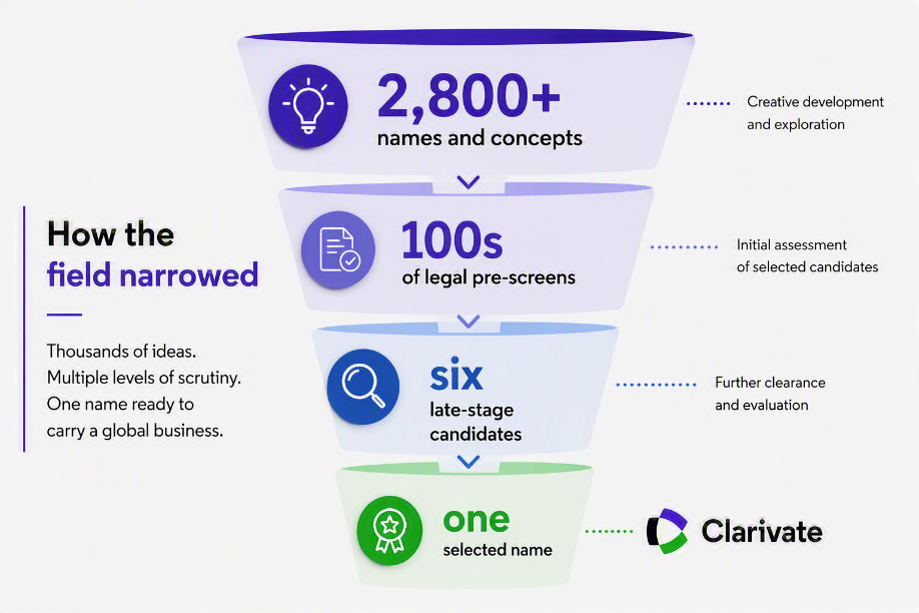
More than 2,800 names and concepts were considered during the project. An internal naming exercise alone generated around 1,000 submissions, but no final choice emerged. An international brand creation agency was subsequently engaged to develop further candidates and identity concepts.
A field of that size might suggest almost limitless choice. Inside the project, it felt rather different.
Producing names was not the difficult part. Producing names we could use was rather harder.
Every new candidate created further questions. Did it meet the creative brief? Would it work across the markets in which the company operated? Could the business acquire the corresponding domain? Most importantly, did the evidence justify the deeper international work required to take it seriously?
The phased approach gave us a disciplined way to answer those questions. Initial work reduced the field before more extensive searches and local opinions were commissioned. Some candidates left the process quickly. Others remained plausible for longer, only to encounter an issue as the scope widened.
Round by round, the field became smaller and the questions became more exacting. By my recollection, around six candidates reached the later stages. Clarivate was one of them.
That number is more revealing than the original 2,800. Creative volume gave the business room to explore. Progress came from reducing that volume without allowing enthusiasm for one candidate to get too far ahead of the evidence.
Clarivate did not emerge fully formed from a moment of inspiration. It stayed in the process as the questions became more demanding.
When a creative idea meets the real world
By late September, the project had moved well beyond the original question of whether people liked a name.
The remaining candidates had undergone full searches in key markets, supported by national legal opinions. The results were then being considered alongside intended use, domain position and the practical requirements of the launch.
That broader view mattered. Search results rarely amount to a convenient answer delivered in isolation. Potentially relevant records must be understood in the context of the marks, goods and services, markets concerned and the business position the new identity will occupy.
By the final week, that judgment had become rather less theoretical.
With one week remaining, the Phase II legal opinions for two of the leading candidates had arrived. The position for CLARIVATE looked promising and no significant obstacle had been identified in the principal markets reviewed at that stage. Further searches were underway in important secondary markets, however, and external counsel still needed to complete its assessment. A preliminary go or no-go recommendation was expected within days, with trademark applications potentially following soon afterward.
I continued to urge caution. The evidence was moving in the right direction, but searches and opinions remained outstanding. In my update to the team, I wrote that it was “too early to CLARIVATE just yet.”
The pun has survived rather better than I expected. The caution behind it was serious.
A search result is not a decision. The practitioner’s work begins with what has been found. By this stage, our task was to present the evidence clearly enough for Legal and the business to understand the remaining risks, reconcile them with the commercial deadline and decide whether Clarivate was ready to proceed.
Four days later, my recommendation was ‘yes’. The project team moved forward with Clarivate, while the outstanding work continued toward filing and launch.
The name was only half the identity
The name attracted most of the attention, as names tend to do. But we were launching an identity, not a word.
Clarivate would appear alongside a new visual identity led by the ‘C’ lens. The name, symbol and combined presentation needed to work coherently across the company’s products, services and communications.
Trademark professionals will recognize the coordination problem. A name may gather internal support while its visual system is still developing, yet the business ultimately launches both. The relevant question was therefore not simply whether the word could proceed, but whether we had considered the identity customers would actually encounter.
The lens therefore had to be considered within the wider trademark work before launch. It was not enough to establish a position around the word and then treat the visual identity as a separate design exercise. The business needed confidence in the identity it would actually present to the market.
There was also an immediate question about how the name itself would be used. The company would launch formally as ‘Clarivate Analytics’, while Clarivate would appear on its own in day-to-day use, signage and logos. That distinction affected the filing position because the business intended to use and build recognition around the shorter mark from the outset.
The same thinking extended to the digital identity. The principal domain had to be acquired, related domains protected and the intended online use agreed before launch. It was essential that the trademark and domain strategies developed together rather than as independent workstreams.
In practical terms, that was the identity we were clearing: a company name, a shorter everyday mark, a visual device and the online presence through which customers would encounter them.
Why Clarivate survived
It is easy to make a selected name sound inevitable once the naming rationale has been written. That was not why Clarivate remained in contention.
The name was lightly coined from three ideas: clarity, making complexity easier to understand; activate, turning insight into action; and innovate, helping ideas and progress move forward. Together, they expressed something of what the new business intended to become. The original launch materials used the same derivation in explaining the name to colleagues and customers.
The rationale gave the business a credible story. It could not make the name usable.
Many candidates can be given a persuasive explanation once their component parts are unpacked. Clarivate stayed in the process because the creative case and the practical evidence continued to support one another. The name was broad enough for the business, capable of being introduced across markets and supported by a trademark, domain and commercial-use strategy.
Even then, further work was required. The clarivate.com domain was already registered and had to be acquired. Research also connected the registrant with a dissolved Irish company that had previously used the name, prompting additional company-name and trademark checks. The earlier use did not appear to present a significant concern, but it reinforced an important point: the trademark position, company-name history, domain and intended use all formed part of the same commercial decision.
For trademark teams, that wider view is often where the value lies. A search may identify the record that first attracts attention, but the surrounding evidence helps establish whether it represents a material obstacle, a manageable issue, or simply something that requires further investigation.
On September 30, 2016 external counsel confirmed that the United States trademark application had been filed. I described that as having “laid down our marker” from an IP perspective. Subject to final Legal input, the business looked rollout-ready.
Three days later, colleagues received the Day 1 announcement:
“The legal and financial ownership of IP & Science has transferred from Thomson Reuters to Onex and Baring Asia and we are now called Clarivate Analytics. 3 October 2016 is Day 1 of our new company.”
The simplicity of that announcement was the outcome the entire project had been working toward.
A decade later, the associations within the name remain recognizable. Clarity, action and innovation still speak to the role Clarivate aims to play: a trusted innovator, combining the confidence that comes from established data and expertise with better ways to put them to work.
But Clarivate survived the original process for a more immediate reason: it made sense creatively and continued to hold up commercially.
Five lessons for anyone naming a global brand
No two naming projects will have the same markets, timetable or appetite for risk. Looking back at the Clarivate project, however, I would carry five principles into the next one.
1. Define viability before preference takes over
The brief must establish what the business will require from a usable name, not merely what it hopes the name will communicate.
That includes the markets, intended use, relevant goods and services, domain position and the level of international investment the business is prepared to make. If those requirements appear only after a favorite has emerged, the evidence has to compete with an emotional decision that may already have been made.
2. Preserve credible alternatives for longer than feels comfortable
A preferred candidate can acquire momentum quickly. Designs appear around it. Stakeholders learn its rationale. The name begins to feel more real than the alternatives.
That is precisely why the alternatives matter. A serious candidate field gives the business room to respond when the evidence changes. It also makes it easier to assess each name on its merits rather than treating every adverse finding as something to overcome.
3. Search where the next answer will change the decision
The sequencing of the work was one of the most important choices we made.
Beginning with priority markets and questions allowed us to remove candidates before commissioning wider international work. Deeper searches could then concentrate on the names that still justified the investment. The principle was straightforward: find out what matters next, then allow the answer to determine what work follows.
4. Treat the mark, domain and intended use as one commercial decision
Different specialist teams may own these questions, but the eventual brand has to live with all of the answers.
In this project, the trademark position affected the filing strategy. The intended use of Clarivate and Clarivate Analytics affected what needed to be filed and supported. The domain strategy had to secure both the primary public address and the wider digital footprint.
Coordinating those decisions early gave the business a more realistic view of whether a candidate was genuinely ready for launch.
5. Put one team in charge of the route to launch
The work brought together customized screening, full searches, local legal opinions, external counsel, domain acquisition, defensive registrations and social-handle protection. The individual services mattered. Their coordination mattered more.
The message sent to the project team after Day 1 described the work as an end-to-end effort delivered within a very tight timeframe. I was described afterward as the ‘virtuoso conductor’ of the CompuMark orchestra. I might question ‘virtuoso,’ but not the need for a conductor.
The business did not need a collection of disconnected outputs. It needed each specialist to understand the decision being made, the remaining risks and what had to happen next.
That is the role an end-to-end partner can play when a naming project reaches the point at which time, evidence and commercial ambition all have to converge.
The work behind the word and the work behind the work
For ten years, Clarivate has appeared in public as a single, settled word.
Few people encountering it today would know about the thousands of possibilities, the successive rounds of evidence or the professional judgments that preceded it. They would have no reason to. This was the work behind the work: the searching, interpretation and coordination required before one familiar word could appear confidently in the market.
That apparent inevitability is part of what makes a successful name work.
Looking back, what interests me most is not that one candidate survived and the others did not. It is the way trademark intelligence changed the quality of the choice. The creative work generated possibilities. CompuMark gave the business a structured way to test them, direct deeper work toward the strongest and understand what the evidence did, and did not, allow us to conclude.
The project also offered an unusual view of our own capabilities. I knew each part of the operation well; experiencing them as one coordinated service made their collective value much more tangible.
Clarivate did not emerge from one inspired moment. It was created, tested, interpreted and chosen.
That is the paradox of a successful name: once it works, the work behind it becomes almost invisible.
A strong name needs more than a strong idea
When a naming or rebranding project carries a fixed deadline and international ambition, CompuMark provides a more structured route from candidate generation to an informed clearance decision.
Global trademark data, search technology and specialist expertise help legal and business teams screen prospective names, investigate potential conflicts and concentrate deeper work on the candidates that remain credible.
Explore trademark search and clearance


Related insights
The latest news, technologies, and resources from our team.


