The rise of agentic AI in IP: What patent and trademark teams need to know about AI agents

Patent and trademark teams have already seen generative AI (GenAI) support research, intelligence and drafting. Even as models continue to improve, the most capable AI is only as effective as the data and context it can access.
The real opportunity is unlocking decades of commercial, technical and legal insight embedded across IP data and putting it to work in everyday decisions.
This is where agentic AI comes in. Effective agents combine access to data with an understanding of a specific task, drawing on the reasoning patterns and expertise that professionals use to determine the next step. Their actions and recommendations stay transparent, allowing human experts to review, guide and redirect them when needed.
Here’s what patent and trademark teams need to know about AI agents.
What is an AI agent?
An AI agent differs from the earlier generations of conversational AI in that agents can autonomously perform actions. Ask a chatbot an IP-related question and you get a response. Give an AI agent a defined task, such as summarizing a trademark record or classifying an invention disclosure, and it works out what to look up, gathers the relevant information and prepares an output for review.
Purpose-built agents mimic how professionals approach a task, applying trained logic to determine the next best action. For example, an AI agent can follow established search methodologies, combining techniques such as semantic search, citation analysis and classification codes, while assessing relevance and refining its approach as it works toward a result.
AI agents are often described as acting like junior team membersbecause they can perform tasks and sort through complex data. They are quick to deliver but need oversight and supervision. However, this analogy can be misleading. Unlike junior associates and assistants, AI agents can’t independently learn from experience or act on best judgment.
AI agents excel at repeatedly completing clearly defined tasks and applying the same structured process each time. In practice, they work best within a controlled workflow, alongside reliable data sources and clear rules. For patent and trademark professionals, this means establishing boundaries around AI workflows and applying professional judgment to every output.
Hear from AI experts. Watch The rise of agentic AI in IP: What does the shift mean for patent and trademark professionals?
What is the implication for IP teams?
For IP teams, the value of AI agents spans across roles and across strategic and tactical workflows.
- For chief IP counsel, AI agents can unify IP intelligence across teams and provide a scalable approach to AI adoption.
- For IP counsel, AI agents can accelerate research, help maintain rigor while reducing effort and provide a more intuitive way to interact with IP data.
- For IP operations managers, AI agents can drive operational efficiency, reduce manual effort and duplication and lay the foundation for scalable process transformation.
Putting AI agents to work in trademark clearance
Consider a first-pass trademark clearance. Traditionally, this would take a trademark attorney multiple hours to research, organize and prepare for judgment.
With AI, several agents working within a defined workflow could quickly:
- gather validated trademark, litigation and case-law information,
- assemble a summary,
- route it to the right reviewer and
- flag the next step for approval.
Throughout this example, professional judgment and legal reasoning stay with the professional. The agent prepares, organizes and moves information. The attorney reviews it, questions it and decides what happens next. The decision and the accountability stay exactly where they have always been.
However, an AI agent is only as capable as the information it can reach. In this example, the agents need access to comprehensive and trusted data across trademark, litigation and case-law sources . Without reliable data sources, the AI-generated summary report might miss crucial information needed to clear a mark. This is where most organizations hit a wall.
Why do AI agents need connected data, and what is an MCP?
IP data are a rich source of commercial, technical and legal insight, but in many organizations it sits in disconnected pockets and legacy tools. Linking an AI model to each source has traditionally meant building and maintaining a custom integration, one connection at a time. But this approach is hard to replicate at scale for AI agents.
The Model Context Protocol (MCP) changes that equation. Think of an MCP as a universal plug for AI: rather than a different connector for every device, one standard port fits everything. MCP is an open-source standard that gives AI systems a common way to connect to data sources and tools. It replaces a tangle of custom integrations with connected, data-grounded AI that is simpler to build and easier to oversee.
For IP teams, the quality of an AI agent rests on the quality of the data behind it. An agent connected only to the open web can guess and predict from what sits in the public domain. An agent connected to authoritative, curated IP data through MCP can work to the standard that patent and trademark decisions demand.
Find out more about the CompuMark Trademark MCP.
Why does trusted IP data matter for AI agents?
Reliable decisions depend on reliable information. Without a foundation of trusted data, the results delivered by AI agents can be riddled with inaccuracies and omissions. If these errors are fed into the next step of an IP workflow, they can spread.
For example, incomplete trademark data could weaken a clearance assessment. Missing patent records could affect a prior-art review. Inaccurate legal status information could lead to inappropriate follow-up action. Poor ownership data could distort a portfolio review.
IP teams need to know where the data came from, whether they are current, how they have been structured and whether they are appropriate for the workflow. They also need to know whether AI agents can show supporting evidence and if review processes can be built in before action is taken.
This is especially important when AI agents can connect to enterprise systems, APIs, MCPs or external environments.
Data shows that governance cannot be treated as an afterthought. Privacy, professional liability and compliance concerns remain the most common barriers to wider AI adoption, cited by 58% of respondents overall and 65% of attorneys. For AI agents and agentic workflows, those concerns become even more important because AI may support not only an answer but also the next step in a process.
Watch the on-demand webinar: Hallucinations in trademark practice: Why only verified data can keep you safe.
How can AI agents support patent workflows?
Patent teams work with large volumes of technical, legal and commercial information. They need to assess inventions, review prior art, monitor competitors, manage portfolios and support filing or prosecution decisions.
AI agents have the potential to make that information easier to find, organize and review. For example, AI agents can be developed to:
- retrieve patent information from approved sources,
- organize prior-art references around a technical question,
- summarize long documents for professional review,
- identify gaps in invention disclosure information,
- prepare follow-up questions for inventors,
- support portfolio review preparation,
- monitor defined changes in a technology area or competitor portfolio and
- categorize and compare competitors’ patent portfolios using your portfolio taxonomy.
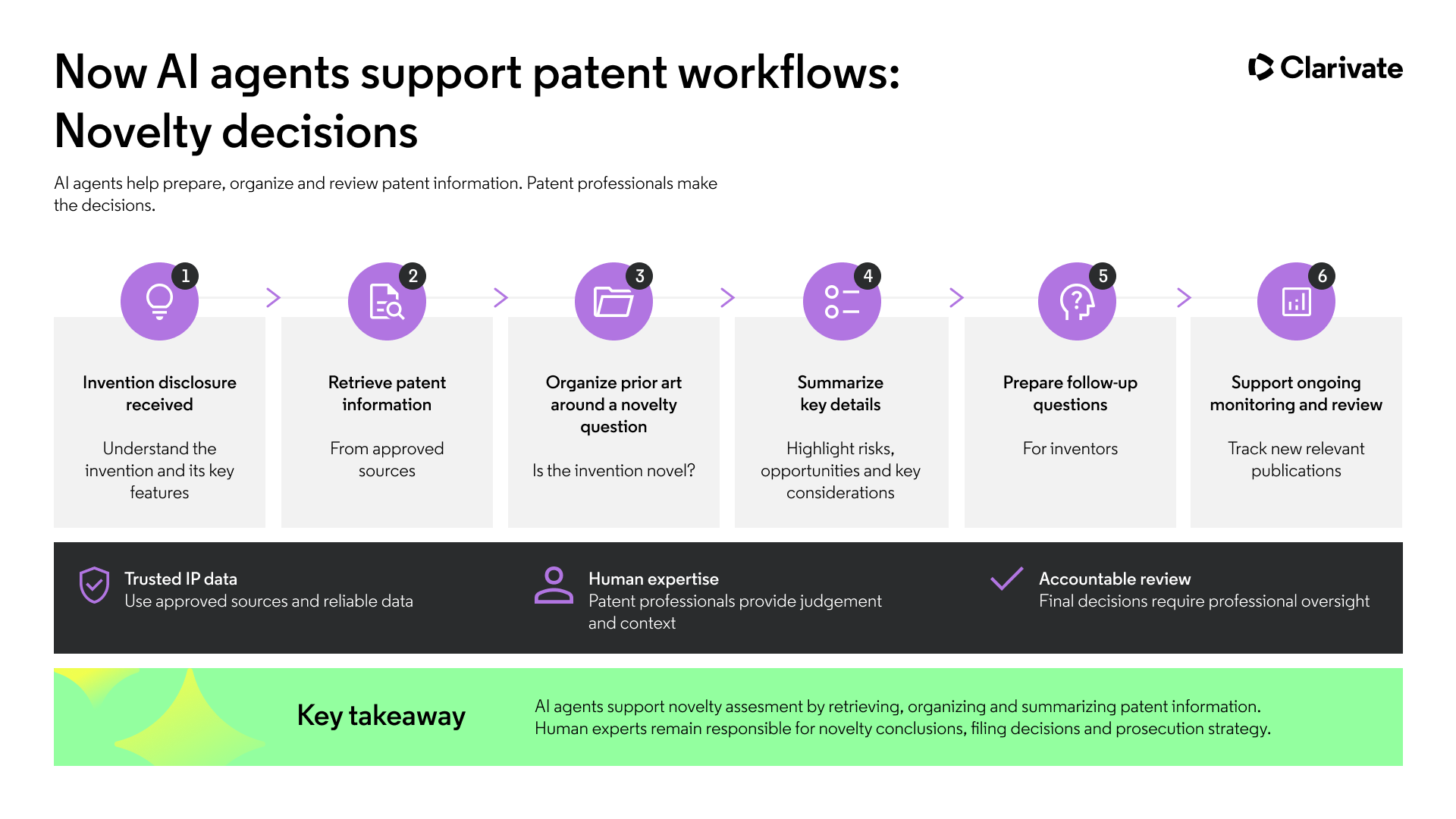
These uses can be valuable because they sit around the work that patent professionals already do. In these scenarios, AI agents help with preparation, organization and review. But they do not remove the need for professional judgment.
Filing decisions, prosecution strategy, claim scope, abandonment decisions and portfolio strategy should remain subject to expert review and accountable approval.
How can AI agents support trademark workflows?
Trademark teams also manage complex, data-rich workflows. Trademark attorneys often search marks, review similarity, assess legal status, monitor portfolios, support clearance and manage business requests across markets.
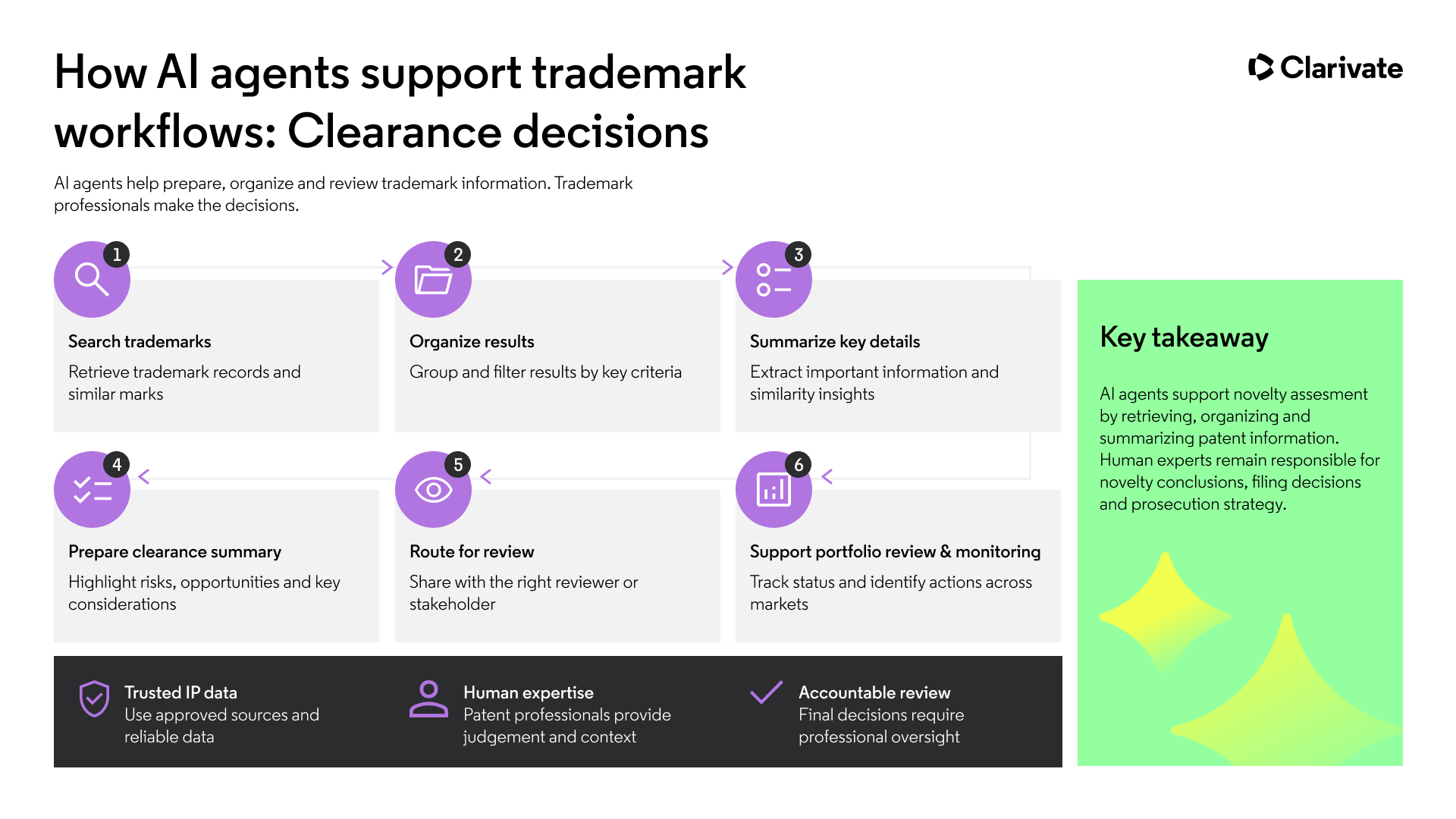
AI agents could help make these workflows more efficient by supporting defined tasks. For example, an AI agent might help:
- retrieve trademark records,
- organize search results,
- summarize key details or
- prepare a clearance summary for review.
In a more agentic workflow, several steps could be connected so that information is gathered, structured, routed and reviewed more consistently. Possible use cases include trademark monitoring, clearance preparation, evidence organization, portfolio review preparation and workflow routing.
As with patent workflows, these AI agents are most valuable when they support preparation, organization and review. Professional judgment, legal reasoning and accountability remain with the trademark professional.
Discover more AI insights. Read The real world-impact of AI on modern IP decision making.
What should IP leaders ask before using AI agents?
Before adopting AI agents or agentic AI in an IP workflow, leaders should start with the business problem.
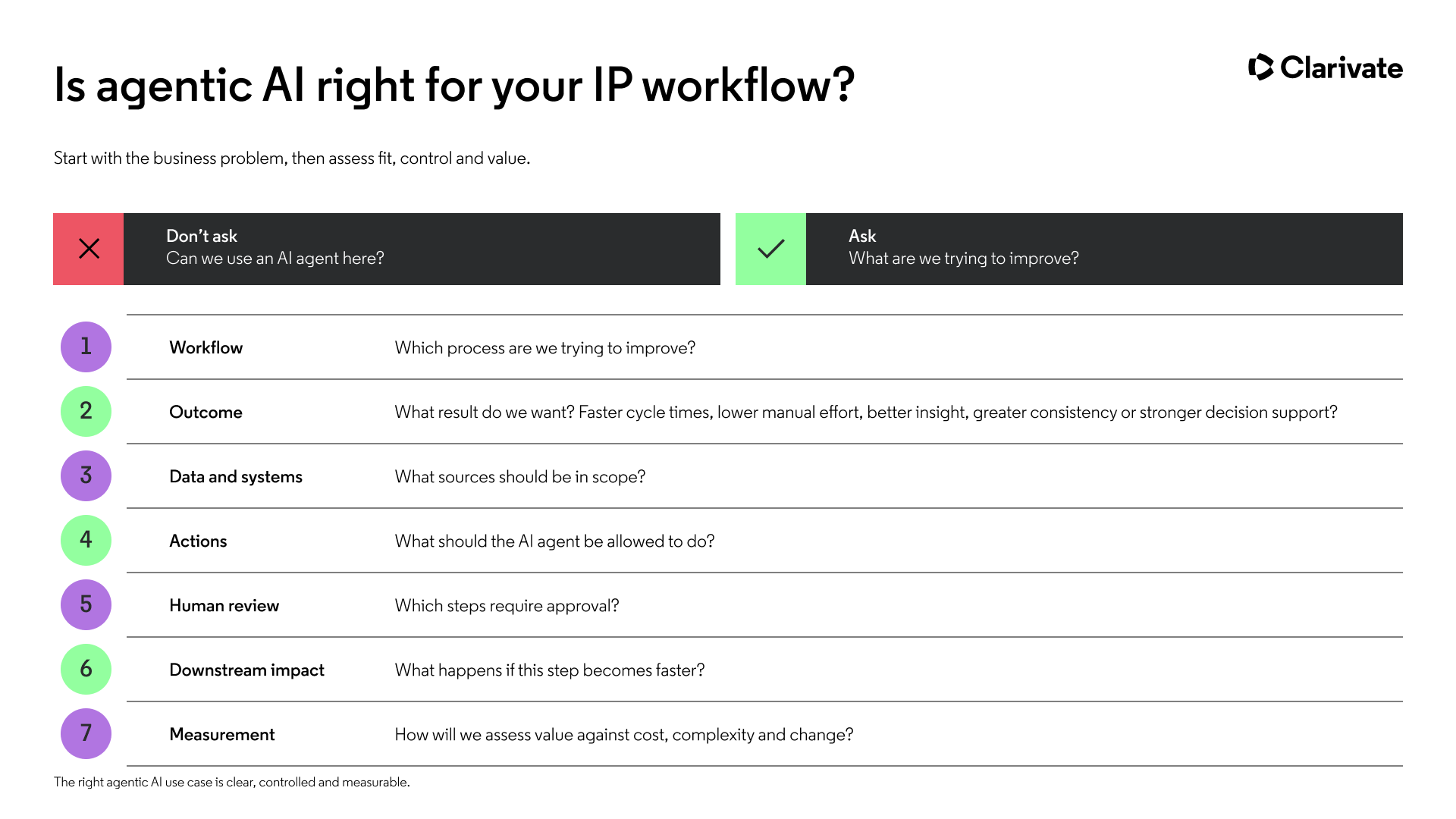
The first question should not be, “Can we use an AI agent here?” It should be, “What are we trying to improve?”
That might be faster cycle times, lower manual effort, better insight, greater consistency or stronger decision support.
IP leaders should also ask:
- Which workflow are we trying to improve?
- What outcome do we want to achieve?
- What data sources and systems should be in scope?
- What actions should the AI agent be allowed to take?
- Which steps require human review or approval?
- What could happen downstream if this part of the workflow becomes faster?
- How will we measure value against cost, complexity and change?
This last question is important. If AI agents help generate more invention disclosures, for example, the organization may also need to manage more prior-art searches, more patentability assessments and more portfolio decisions.
Agentic AI can make parts of the workflow faster. IP teams need to understand whether the wider process is ready for that change.
When evaluating AI, the focus is often on what the technology can do. In IP, however, the more important question is whether the output can be relied on. An AI agent is only as reliable as the data, expertise and processes behind it.
That’s why the most effective AI agents are grounded in authoritative IP data, designed for specific tasks and connected to the workflows professionals use every day.
Reliability also depends on transparency and context. IP teams need to understand where information comes from, review the evidence and apply their own expertise before making important decisions.
The best AI agents help accelerate research, analysis and routine tasks while making it easy to validate findings and maintain confidence in the outcome. They support better decision-making; they don’t replace professional judgment.
Just as importantly, reliable AI agents need clear guardrails. Security, review processes and defined workflows help ensure that AI-generated insights can be applied consistently and responsibly. In practice, that means the real value of an AI agent doesn’t come from the model itself. It comes from combining intelligence, human expertise and proven workflows to help IP teams move faster while maintaining the quality, control and confidence their work demands.
Where can agentic AI add value in IP?
Agentic AI is most likely to add value where the workflow is clear, the data sources are trusted and the permitted actions are limited.
It is also most useful where work involves repeated handoffs, fragmented information or manual preparation.
Potential areas include:
- Trademark monitoring
- Patent information retrieval
- Invention disclosure support
- Workflow routing
- Task preparation
- Evidence organization
- Portfolio review preparation
- Defined follow-up actions.
For organizations building internal AI environments, connected access to trusted IP intelligence may help internal assistants or applications work with more reliable information. But the same principles still apply. Authentication, permissions, review requirements and boundaries must be clear.
Not every IP challenge needs an AI agent. Some tasks may be better served by search assistants, analytics, automation, systems of record, operational services or expert review.
The goal is to apply the right capability to the right part of the work.
Find out more about IPOne, our unified intelligence ecosystem.
Learn more about AI agents and agentic AI in IP
Clarivate brings together trusted IP data and intelligence, established tools and workflows and expert-led services to support confident decisions and reliable execution.
If you are exploring AI agents and agentic AI for your IP team, now is the time to understand what is changing and what practical steps you can take.
In the on-demand webinar, Irene Chang, HP Inc., Azhar Sadique, Aittorney and Clarivate specialists discuss:
- what AI agents and agentic AI mean for IP teams,
- where AI agents may support patent and trademark workflows,
- why trusted data and connected workflows are critical and
- how IP teams can prepare for responsible adoption
Watch The rise of agentic AI in IP: What patent and trademark teams need to know to hear expert perspectives on what AI agents mean for patent and trademark professionals, where they can add value and how IP teams can prepare for responsible adoption.


Related insights
The latest news, technologies, and resources from our team.