From promise to payment: pricing and reimbursement for combination oncology regimens


Combination regimens are increasingly common in oncology, driven by their therapeutic potential. By targeting multiple disease pathways simultaneously, combination regimens offer the promise of improved treatment response and, in some cases, better tolerability through lower individual drug doses.1 This shift is already evident in regulatory trends: between 2016 and 2021, over 40% of oncology approvals from the United States (U.S.) Food and Drug Administration (FDA) were for drugs used in combination with existing therapies, or effectively used as add-on therapies following approval in the adjuvant, consolidation, or maintenance settings.2
Yet despite their growing clinical role, combination therapies continue to face disproportionate challenges at the reimbursement stage, with evidence showing they are more likely to be rejected than monotherapies (Figure 1).3
Figure 1: Percentage of drugs in lung cancer and multiple myeloma rejected for reimbursement across EU5 countries (1 January 2011 to 31 December 2020)
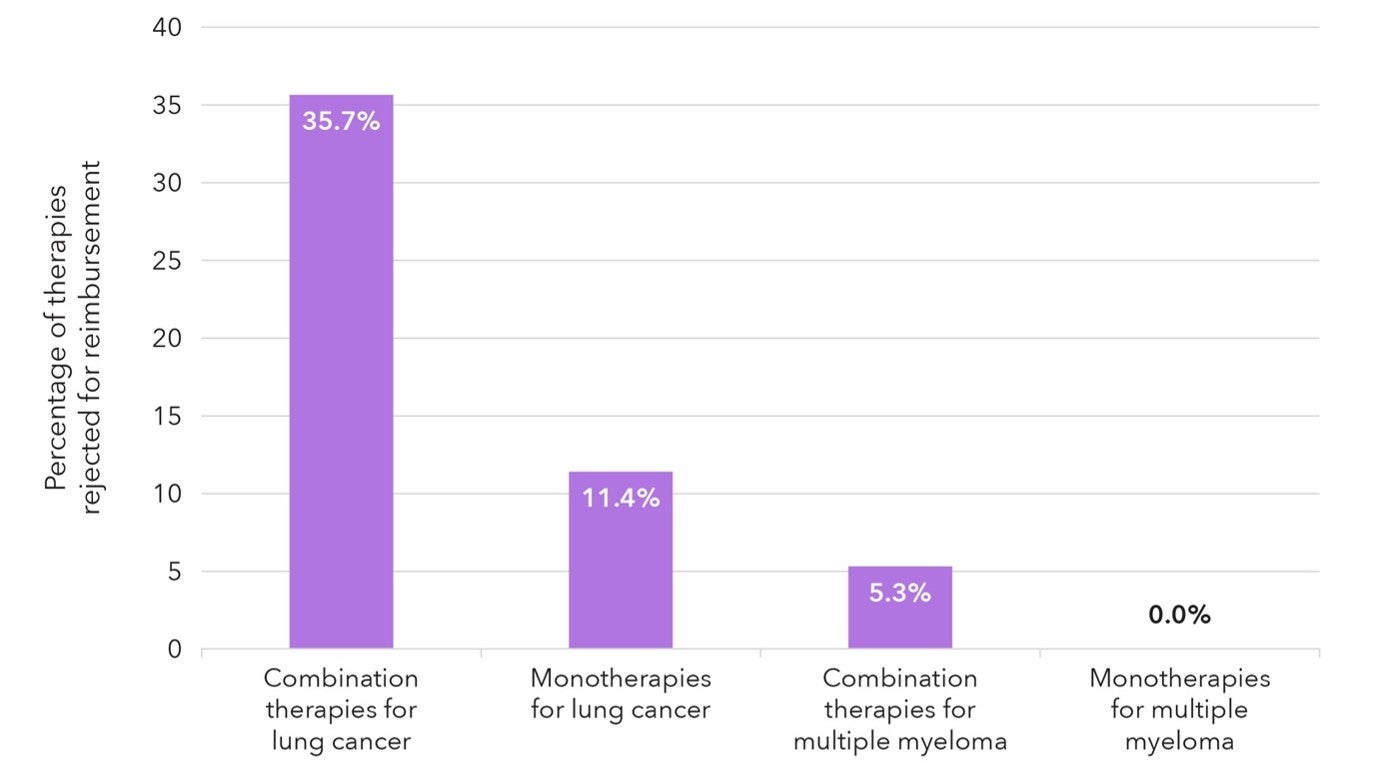
Source: Izmirlieva et al, 2022 (3).
Even when the clinical rationale for using combination regimens is strong, access is often limited, delayed, or denied. On average, only 55% of fixed‑dose combination therapies with central marketing authorization between 2020 and 2023 were available to patients in the European Union (E.U.), according to the Patients WAIT Indicator Survey.4
Why are combination therapies often not perceived as good value for money?
A big part of the challenge is that increases in cost are not always matched by increases in clinical benefit. When a regimen is formed from two established monotherapies, the additional clinical value generated by using them together may not be proportional to the added cost of paying for both products.1 In those cases, combination treatments may not be considered cost‑effective.
But there is another, more counter‑intuitive issue: success can increase costs. If a combination extends survival, patients may remain on treatment for longer, resulting in accrual of costs over additional time.1 This becomes especially challenging when a new add‑on is paired with a backbone therapy that was already priced near the upper limit of what the system is willing to pay for its clinical value. If there is little capacity to fund the combined costs over a longer treatment duration, the regimen may not be considered cost‑effective, even if the add‑on were supplied free of charge.
Tackling this disconnect between component-level pricing and regimen-level value is important when seeking market access for combination treatments. This requires demonstrating not only the added clinical benefit of the regimen, but also how that benefit relates to treatment duration, component costs, and the contribution of each therapy.
To do so, the added clinical benefit of the regimen should be highlighted alongside how that benefit relates to treatment duration, component costs, and the contribution of each therapy.
Which strategies are adopted by Health Technology Assessment bodies and pricing/reimbursement authorities?
While Health Technology Assessment (HTA) bodies are testing different options, formalized solutions are still uneven across markets. In a 2020 study spanning 25 Organization for Economic Co-operation and Development (OECD) and E.U. countries, the vast majority were found to have no formalized methods for pricing combination products.5 Where approaches exist, they commonly involve negotiation to adjust prices when the combined list price exceeds willingness‑to‑pay thresholds.5
Some systems try to manage affordability by negotiating within the combination itself. In France, authorities can set an overall price for the regimen and then negotiate confidential prices with each manufacturer.5 In Belgium, when a company seeks coverage for an add-on product, they are typically expected to adjust the add-on price so that the combination is affordable, because the backbone price often remains unchanged.5
Other approaches focus on enabling sponsors to work together on pricing solutions without breaching competition rules.6 However, such collaboration must be carefully structured within existing competition law frameworks.5 With that in mind, the U.K. has established a framework enabling two competing companies to exchange information and negotiate commercial arrangements for combination treatments.7, 8 Even so, developing competition law‑compliant solutions can be challenging in many jurisdictions,6, 9 and the benefits of negotiating bespoke arrangements by indication and market may need to be carefully weighed up.6
A different approach is to apply fixed, percentage-based price reductions when treatments are used in combination. Germany, for example, introduced a 20% price reduction for products used in combination in certain circumstances.6 While this can create budget headroom for add‑on products,6 it does not assess the relative contribution of individual treatments.
Although HTA agencies do not typically allocate explicit value shares to individual components of a combination,5 value attribution could help inform how prices might be set.9 Value attribution frameworks have been developed for reimbursement, but there is currently no formally accepted or standardized methodology.9
In our experience, no single mechanism resolves access challenges in every setting. Approaches need to be market specific and consider local pricing architecture, ownership of regimen components, and the availability of indication-specific arrangements.
How could indication-based pricing unlock access to combination regimens?
Indication-based pricing (IBP) reflects a simple reality: the same medicine can deliver different therapeutic value in different indications. IBP allows price to vary by use, rather than being limited to one price across all settings.10 In practice, IBP could be delivered by calculating a weighted average of value and utilization across indications, applying indication-specific discounts or rebates, using indication-specific branding, or implementing performance‑linked price adjustments agreed by manufacturers and payers.11
In systems that enforce a single net price across all indications (uniform pricing), such as the UK, it can be more challenging to recognize value for follow‑on indications. In contrast, IBP has the potential to support better alignment between price and value, which in turn may improve resource allocation and incentives for research and development, while also encouraging price competition and better overall value for health systems.11,12
Stakeholders have an appetite to explore IBP. In a 2020 global survey across 16 countries (N=73; including representatives from industry, payers, regulators, and academics, among others), 78% agreed when asked, “would some form of IBP be a good thing?”, and 57% believed that all stakeholders could stand to gain.12 These findings suggest momentum toward more flexible pricing models, particularly as treatment strategies evolve beyond single‑agent use.
Why IBP and value attribution matter
Ultimately, the practical question facing combination regimens is whether pricing and reimbursement rules can keep pace with how combinations are used in the real world. For an add‑on treatment to earn revenues reflecting its contribution within a combination, the backbone will likely need to be priced lower for combination use than for monotherapy, and payers would need to operationalize IBP or allow revenue‑sharing.6
Where IBP is available, manufacturers of backbone drugs may be willing to accept a lower price in the relevant indication, because reimbursement of the combination may increase backbone utilization.5 However, if any backbone price reduction would automatically apply across all indications (because IBP is not supported), the manufacturer may have little incentive to agree to a lower price that is not offset by the expected increase in combination‑driven uptake.5
Without a workable roadmap to allocate value between the backbone and the add‑on, backbone therapy manufacturers may retain disproportionate bargaining leverage.6 Over time, this dynamic could discourage development of add‑on therapies and limit potential health gains.6 In some circumstances, an add-on manufacturer may create their own backbone drugs to avoid these constraints6 unless the backbone product is off-patent and available as a generic or biosimilar. This could lead to a need for additional trials, inefficient resource use, and added complexity in clinical practice.6
Advancing frameworks for access to oncology combination therapies
To improve patient outcomes in oncology, innovative combination regimens need to translate into positive reimbursement decisions and timely patient access. IBP could be part of the solution, but sustained progress is likely to depend on HTA and pricing/reimbursement bodies taking a more explicit role in defining practical approaches to value attribution for combination therapies.
Clarivate understands that value attribution should be practically considered throughout evidence generation and value communication, including during dossier development. Clarivate’s HTA and Value Communication experts specialize in developing strong value narratives that support clear product positioning and informed HTA and reimbursement decision‑making. Our consultants have supported oncology assets, including combination regimens, across many cancer types, helping clients articulate robust value propositions tailored to payer and HTA needs. For more information, or to get in touch with a member of our team, contact us here: Healthcare Commercial Consulting Services | Clarivate
References
- Latimer NR, Pollard D, Towse A, Henshall C, Sansom L, Ward RL, et al. Challenges in valuing and paying for combination regimens in oncology: reporting the perspectives of a multi‐stakeholder, international workshop. BMC Health Services Research. 2021;21(1):412.
- Benjamin DJ, Xu A, Lythgoe MP, Prasad V. Cancer Drug Approvals That Displaced Existing Standard-of-Care Therapies, 2016-2021. JAMA Network Open. 2022;5(3):e222265-e.
- Izmirlieva MA, Reinaud F, Taiyeb M, Ando G. P29 Reimbursement Outcomes for Combination Therapies vs Monotherapies in Lung Cancer and Multiple Myeloma in the Top Five European Markets. Value in Health. 2022 2022/01/01/;25(1, Supplement):S7.
- European Federation of Pharmaceutical Industries and Associations. EFPIA Patients W.A.I.T. Indicator 2024 Survey. 2024. Accessed May 2026. Available online at: [https://efpia.eu/media/oeganukm/efpia-patients-wait-indicator-2024-final-110425.pdf].
- Organisation for Economic Co-operation and Development (OECD). Addressing challenges in access to oncology medicines. 2020. Accessed May 2026. Available online at: [https://www.oecd.org/content/dam/oecd/en/publications/reports/2020/04/addressing-challenges-in-access-to-oncology-medicines_5f0e2f62/699520d0-en.pdf]. .
- Towse A, Briggs A, Steuten L. Pricing combination products: not how but who? The European Journal of Health Economics. 2025 2025/04/17.
- Competition & Markets Authority. Prioritisation statement on combination therapies. 2023. Accessed January 2026. Available online at: [https://assets.publishing.service.gov.uk/media/6554fd97d03a8d001207f9f9/Prioritisation_statement_on_combination_therapies.pdf].
- European Federation of Pharmaceutical Industries and Associations. Access to oncology combination therapies in Europe: moving forward. 2024. Accessed January 2026. Available online at: [https://www.efpia.eu/media/e5fljxe2/access-to-oncology-combination-therapies-in-europe-moving-forward.pdf].
- Gaultney JG, Ollendorf D, Sasane M, Fernandez C, Paranjpe K, Chen T-Y, et al. Value attribution for oncology combination regimens: going beyond frameworks to balance innovation, access, and affordability. Frontiers in Pharmacology. 2025 2025-July-02;Volume 16 – 2025.
- Preckler V, Espín J. The Role of Indication-Based Pricing in Future Pricing and Reimbursement Policies: A Systematic Review. Value in Health. 2022 2022/04/01/;25(4):666-75.
- Cole, A., Towse, A., Zamora, B. Indication-Based Pricing (IBP) Discussion Paper: Should drug prices differ by indication? Office of Health Economics Briefing. 2019. Accessed May 2026. Available online at: [https://www.ohe.org/publications/indication-based-pricing-ibp-discussion-paper-should-drug-prices-differ-indication/].
- Cole, A., Towse, A., Zamora, B. Indication-Based Pricing (IBP) Consultation Report. Office of Health Economics Contract Research. 2020. Accessed May 2026. Available online at: [https://www.ohe.org/publications/indication-based-pricing-ibp-consultation-report/].


Related insights
The latest news, technologies, and resources from our team.