Economic and geopolitical pressures shaping elective medtech markets in 2026


As 2026 unfolds, deferrable medtech categories, particularly highly elective treatment areas like medical aesthetics, are providing early signals about how macroeconomic and geopolitical forces are reshaping demand and the outlook for medtech markets. While innovation pipelines and clinical fundamentals remain intact, external pressures are increasingly influencing purchasing behavior, pricing decisions, and near‑term growth trajectories.
What is emerging is not a structural breakdown of these markets, but a recalibration—one that calls for more nuance than traditional cycle‑based assumptions.
Elasticity, not recession, is driving pressure
Although 2025 did not meet the technical definition of a recession in the U.S. or Europe, economic uncertainty resulted in disproportionate softness in highly elective, cash-pay procedure areas. This reflects a familiar but often underestimated dynamic: economic elasticity.
In deferrable categories, even modest shifts in affordability, confidence, or perceived financial risk can lead to outsized changes in demand. Medical aesthetics surfaced this behavior earlier than many other medtech segments, not because long-term demand weakened, but because patients retained flexibility to delay treatment decisions.
Diverging performance across medtech markets
Market performance over the past year highlights a growing divergence among companies operating under the same macro conditions. Some medtech competitors reflected near-term softness directly in financial results, while others absorbed cost pressures internally to protect pricing, sustain utilization, and defend share.
Mid-tier and smaller players, by contrast, often face longer recovery paths due to more limited capacity to absorb cost shocks or offset demand softness.
Geopolitical pressures on medtech markets in 2026
Earlier market concerns focused heavily on tariffs. That risk has not disappeared, but it has been overtaken by a broader and more persistent set of challenges tied to geopolitics.
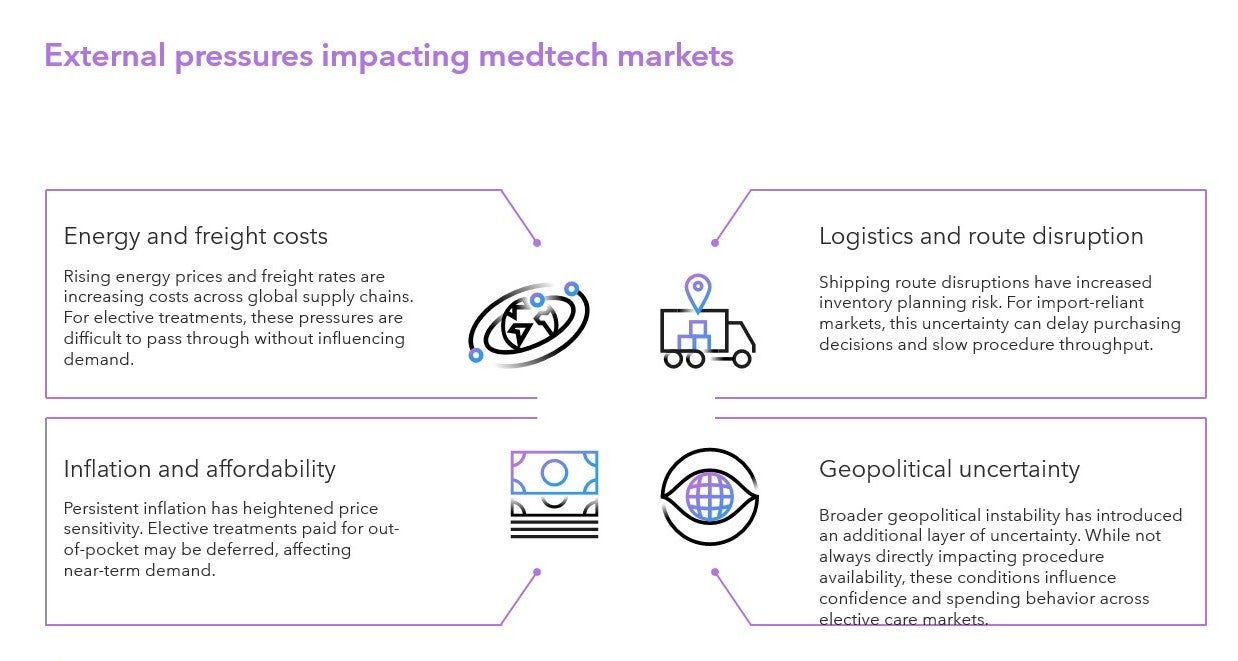
For instance, geopolitical tensions, particularly in the Middle East, have introduced sustained pressure through:
- Higher energy and freight costs
- Shipping route disruption and longer lead times
- Increased uncertainty around inventory planning
These pressures matter disproportionately in deferrable medtech segments, where rising costs are difficult to pass through without affecting demand, especially in price-sensitive markets.
Why growth expectations are moderated in deferrable treatment markets
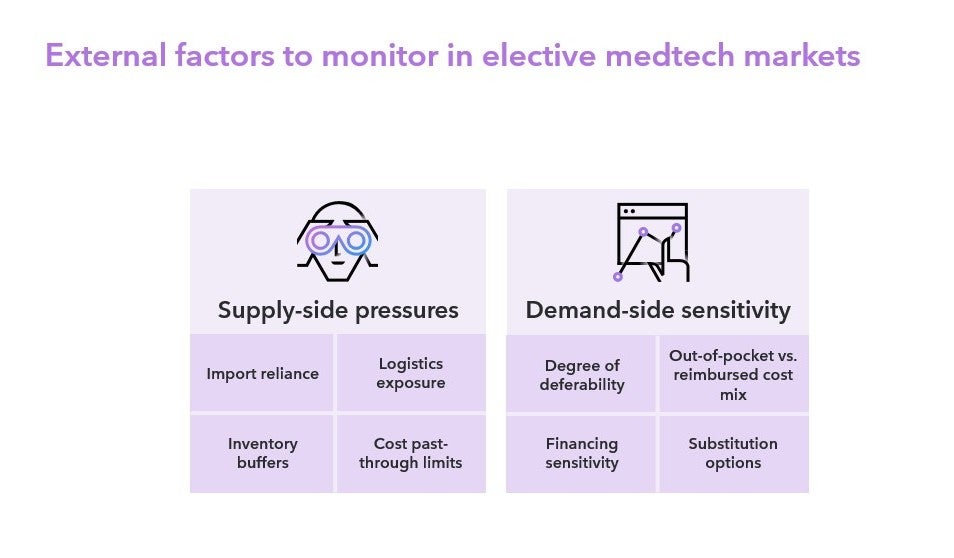
In medtech markets with deferrable treatments such as medical aesthetics, early expectations for a sharp post-2025 rebound have increasingly given way to more measured near-term outlooks. This is not driven by weakening long-term demand. Escalating energy costs, freight inflation, and logistics disruption have added friction to an environment already shaped by affordability concerns.
In cash-pay and elective settings, these pressures influence both provider purchasing behavior and patient decision-making more immediately than in medically necessary or reimbursed treatment areas.
Current signals instead suggest:
- Muted near-term growth in deferrable treatments
- Expected recovery in these areas, but at a more gradual pace
- Stabilization of volumes before re‑acceleration
Beyond aesthetics: implications for other medtech markets
Currently, less deferrable and reimbursement-driven device markets remain structurally more insulated from these short-term demand adjustments.
While aesthetics has served as an early indicator for more deferrable treatment areas, similar dynamics could apply across other medtech segments, including parts of orthopedics, dental, and other markets centered on more elective treatments.
The broader takeaway for 2026 is clear: elective medtech markets remain resilient, but companies must adapt how they respond to evolving external pressures.
Organizations that recognize these changes early, adjust expectations thoughtfully, and identify which markets are most exposed to external shocks will be better positioned to navigate current market conditions.
Turning insight into action in a changing medtech landscape
As economic and geopolitical pressures reshape elective medtech markets, decision‑makers need timely visibility into where demand is shifting, how pricing pressure is evolving, and which segments are most exposed to external shocks.
Clarivate’s Medtech intelligence solutions help organizations:
- Track procedure volumes and utilization shifts across care settings
→ EU Procedure Finder | DRG Commercial Analytics 360 - Understand pricing pressure and demand sensitivity in elective segments
→ PriceTrack - Benchmark market trends, growth outlooks, and competitive dynamics
→ Medtech 360
Explore the full Medtech portfolio.


Related insights
The latest news, technologies, and resources from our team.