Knowledge graphs: Turning fragmented biomedical data into connected, actionable insight

In life sciences, the challenge is no longer access to data, it is making sense of it. From scientific literature and clinical trials to omics datasets and safety databases, researchers are navigating an increasingly complex and fragmented landscape. While the volume of information continues to grow, the ability to translate that data into clear, reliable, and actionable insights remains limited.
In our recent webinar, “AI-powered Knowledge Graphs for Next-Generation Biomedical Decisions,” Matt Wampole (Director, Solution Consulting, Clarivate) joined knowledge graphs experts Gaia Ceddia (Manager) and Anton Kichev (Senior Consultant) from Clarivate’s Discovery & Translational Science (DTS) Consulting team to explore how knowledge graphs can help bridge this gap. The session introduced the fundamentals of knowledge graphs, showcased real-world applications, and highlighted how combining structured data with AI is reshaping decision-making across the R&D pipeline.
Why data abundance does not equal better decisions
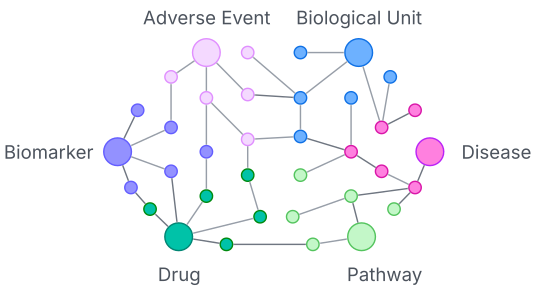
A central theme of the discussion was that biomedical research is now constrained less by data availability than by data usability. As Gaia Ceddia highlighted during the discussion, “the bottleneck is not data volume, it is turning heterogeneous evidence into connected knowledge,” In modern biomedical research, meaningful decisions require connecting mechanisms, indications, biomarkers, safety evidence, and clinical context rather than examining each source in isolation. Data is inherently fragmented across multiple repositories, each with its own structure, curation standards, and terminology. Genes, diseases and drugs are often described inconsistently across sources, making their integration into a unified framework a major challenge. Differences in data quality, reliability and update frequency further complicate traceability and limit trust. This fragmentation limits the ability to build the connected, multidimensional view needed for informed decision-making. Knowledge graphs help address this challenge by connecting fragmented data and evidence into a unified, traceable framework. Understanding a therapeutic hypothesis requires linking mechanisms of action, disease biology, safety and clinical context—something that remains difficult when data is siloed.
While artificial intelligence (AI) and large language models are often seen as a solution, their effectiveness depends on the quality of the underlying data. Unstructured or inconsistent inputs lead to unreliable outputs, highlighting the need for integrated, structured, and trustworthy data as a foundation for meaningful AI-driven insights.
Knowledge Graphs connect fragmented data and evidence into a unified, traceable framework
From concept to impact across R&D
As Anton Kichev highlighted during the webinar, knowledge graphs are already driving impact across the entire R&D continuum. In drug discovery, they support target identification and prioritization by integrating molecular interactions, pathways, and disease associations into a single framework. They also enable exploration of mechanisms of action and potential drug synergies, helping researchers better understand how interventions may perform.
In disease biology, knowledge graphs facilitate the discovery of biomarkers and key regulators by connecting data across multiple biological layers. This systems-level perspective can reveal dysregulated pathways and uncover similarities between diseases, opening new opportunities for drug repurposing.
Their impact extends to clinical decision-making, where knowledge graphs support patient stratification and more personalized treatment approaches by linking clinical, molecular, and safety data. Finally, by structuring information from diverse sources, knowledge graphs enhance literature mining and accelerate knowledge discovery, helping researchers identify, test and validate new hypotheses more efficiently.
Building knowledge graphs at scale with trusted data
A key differentiator of Clarivate biomedical Knowledge Graphs is the strong emphasis on data quality and integration at scale. By combining multiple proprietary, highly curated datasets, including MetaBase, Cortellis Drug Discovery Intelligence (CDDI) and OFF-X, Clarivate creates a comprehensive and unified knowledge graph that captures both depth and breadth of biomedical knowledge.
Through this integration, Clarivate’s biomedical Knowledge Graphs solution brings together highly diverse evidence types, encompassing over 1 million chemical compounds, more than 1 million drugs, nearly 87,000 biological entities, and thousands of disease, pathway, biomarker and safety concepts connected through curated relationships. This breadth of coverage enables researchers to navigate complex biological questions within a single, cohesive environment.
All connections are evidence-backed and fully traceable, ensuring insights remain both interpretable and reliable.
Conversely, many public knowledge graphs often suffer from incomplete coverage or limited maintenance over time. Importantly, knowledge graphs are not static; they continuously evolve by incorporating new evidence and additional datasets — including client data — ensuring alignment with both the scientific landscape and specific research needs.
Making complexity accessible with AI
While knowledge graphs offer powerful capabilities, their complexity can limit adoption. As Anton noted, “one of the obvious challenges of knowledge graphs is retrieving data, because they can become extremely complex, containing millions of nodes and relationships”. To address this, the webinar introduced an AI-powered agent that simplifies interaction by translating natural language questions into graph queries.
By combining AI with structured data, it enables an intuitive workflow—allowing users to retrieve insights and trace them back to their underlying evidence without requiring technical expertise. This integration enhances both the accessibility of knowledge graphs and the reliability and interpretability of AI-driven insights, reflecting a broader shift toward more transparent, data-driven decision-making.
Continuing the journey: upcoming webinars
This session marked the starting point of a broader webinar series exploring knowledge graphs and AI in life sciences. Join us for upcoming sessions:
- September 3rd – Harnessing AI-Powered Knowledge Graphs to Support Biomedical Decisions. Moderator: Irene Robles (Consultant, DTS). Speakers: Verónica Miró (Consultant, DTS) and Natalia Pardo (Senior Consultant, DTS).
- November 5th – Practical Applications of Biomedical Knowledge Graphs. Moderator: Irene Robles (Consultant, DTS). Speakers: Ekaterina Kotelnikova (Associate Director, DTS) and Carlos Perez Roca (Director, Translational Bioinformatics at CSL Behring).
Each session will build on these foundations, diving deeper into applications, case studies and practical implementation strategies.
Explore how Clarivate Knowledge Graphs can transform your research
Knowledge graphs are rapidly becoming a key enabler of next-generation biomedical decision-making, bridging the gap between data and actionable insight.
If you are interested in learning more about how this approach could support your R&D strategy, or in exploring tailored solutions using Clarivate data and expertise, we invite you to continue the conversation.
For those interested in exploring these concepts further, the full webinar recording is available on-demand.
This article was written by: Aida Arcas, Senior Consultant, Discovery and Translational Science; Gaia Ceddia, Manager, Discovery and Translational Science; and Verónica Miró, Consultant, Discovery and Translational Science


Related insights
The latest news, technologies, and resources from our team.