DRG Market Assessment
Access expert curated disease market assessment insights into treatment dynamics, unmet need, competitive shifts, and access factors to size opportunities and shape confident market strategy.
Indication level market assessment revealing what drives today’s disease markets and what comes next
DRG Market Assessment delivers expert curated disease market intelligence that explains how markets behave in the real world. By integrating treatment pathways, competitive dynamics, physician decision drivers, unmet need, and access considerations, it helps life sciences teams evaluate opportunity, refine positioning, and anticipate how markets will evolve.
Drive better decisions with market assessment insights

See the true drivers of disease markets
Get clarity on how diseases are treated today—across treatment pathways, prescribing behavior, unmet need, competitive pressure, access considerations, and physician-reported decision drivers. Understand what’s shaping the market now and what will matter next.
Size and prioritize opportunities with confidence
Leverage deep, indication‑level insights to evaluate market potential, quantify patient opportunity, and identify the most strategically valuable segments and indications for investment.

Stay ahead of competitive and therapeutic shifts
Track emerging therapies, biosimilar disruption, pipeline evolution, and shifting standards of care to understand future competitive market dynamics. Anticipate threats and opportunities early so your strategy stays aligned with where the market is headed—not where it was.
Comprehensive disease market assessment across treatment and competition
Explore expert curated analysis—from disease market context and treatment patterns to competitive positioning and access dynamics—designed to guide commercial strategy across the product lifecycle.
Disease landscape and market outlook
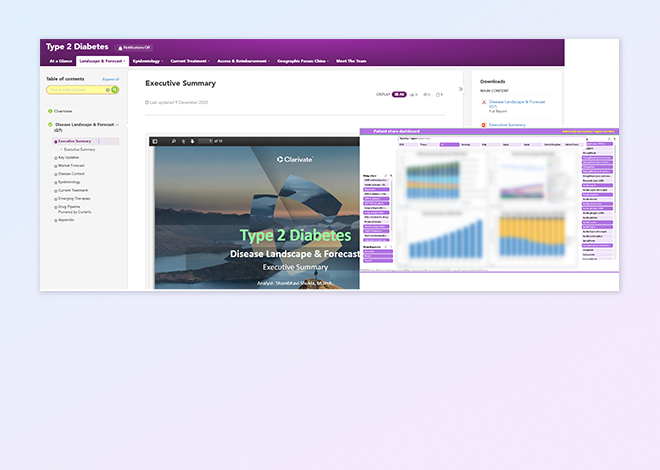
Indication‑level disease market assessment covering disease burden, epidemiology, treatment evolution, competitive activity, biosimilar impact, and long‑range forecasting to support opportunity assessment and lifecycle planning.
Solutions included:
- Disease landscape and forecast
- Niche and rare disease landscape and forecast
- Biosimilars intelligence
- China in‑depth
- Executive insights (on‑demand)
Treatment, physician and access insights
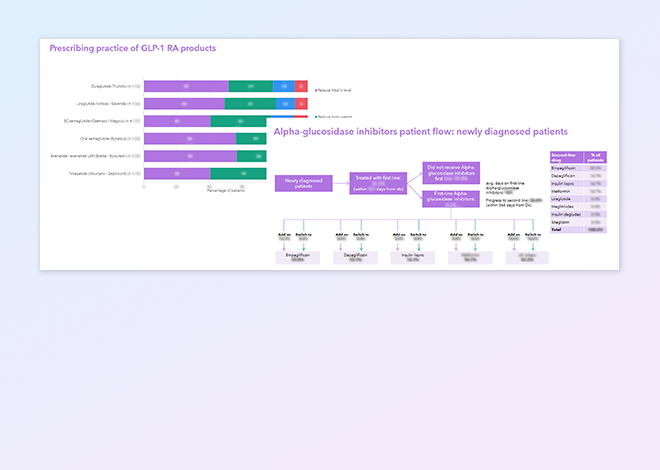
Understand how treatment decisions are made in real‑world clinical practice—and how access, reimbursement, and physician behavior shape adoption. Understand real‑world treatment patterns and the clinical and non-clinical decision drivers shaping brand adoption, prescribing behavior, sequencing, unmet need, and access and reimbursement dynamics.
Solutions included:
- Current treatment: Physician insights
- Unmet need
- Treatment algorithms: Claims data analysis
- Treatment sequencing
- Access and reimbursement
Competitive strategy and market impact
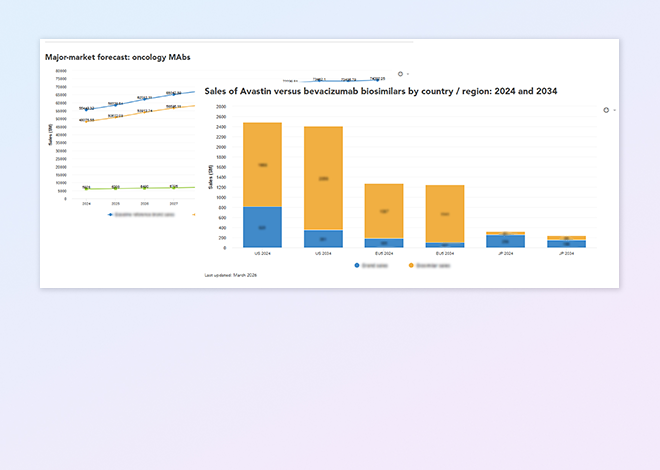
Anticipate competitive threats and positioning opportunities as markets evolve. Anticipate how competitive entry, therapeutic innovation, and standard‑of‑care evolution reshape market share, patient flow, and commercial opportunity.
Solutions included:
- Biosimilars intelligence
- Treatment sequencing
- Treatment algorithms: Claims data analysis
- Disease landscape and forecast
Questions we help you answer with confidence
Market assessment questions that define confident commercial and brand strategy.
- What clinical, competitive, and behavioral factors shape real‑world treatment decisions in this indication?
- Which patient segments and indications offer the strongest commercial opportunity for our brand?
- How will emerging therapies, biosimilars, and evolving standards of care change competitive positioning?
- Where are the unmet needs that matter most to physicians, and what trade-offs are they willing to make in their prescribing decision—and how can we differentiate?
- How do we assess opportunity and differentiate in rare or niche indications where data is limited and markets are still emerging?
Why leading teams rely on DRG Market Assessment?
Expert curated insights informed by extensive primary market research—combining KOL interviews, physician, payer, and market surveys conducted annually
10-year
20+
50+
14
75+
Resources









女性の健康分野で新たな道を切り開く7社
女性の健康:軽視から世界的な投資優先事項へ 何十年もの間、女性の健康は資金不足と研究不足に悩まされてきました。世界人口の半分を占めるにもかかわらず、片頭痛や自己免疫疾患、精神疾患など、女性に多く見られる病状は、その負荷に比べて研究資金が十分に投入されてきませんでした。また、心血管疾患などでも、男性を中心とした研究が長年続いてきたため、女性はしばしば悪い結果に直面してきました。しかし、最近ではこの状況が変わり始めています。こうした格差への認識が高まり、より包括的な研究の推進や投資の拡大、女性の健康をニッチな課題ではなく基本的な優先事項と位置付ける政策の動きが世界的に広がっています。 女性の健康の定義の拡大 現在、「女性の健康」は従来の生殖や婦人科の問題だけでなく、女性に特有もしくは深刻に影響を及ぼす自己免疫疾患なども含まれるようになっています。米国のWomen’s Health Initiative(WHI)や英国のMillion Women Studyのような長期研究により、ホルモンやライフステージの変化が病気に与える役割が解明され、女性により適した公平な医療の基盤が築かれつつあります。 規制による公平性の推進 過去30年で、規制の枠組みは臨床研究や医薬品開発における性差・ジェンダーの重要性をより認識するようになりました。米国では1993年のNIH活性化法が、連邦資金による臨床試験への女性の参加を初めて義務付けました。ヨーロッパ医薬品庁(EMA)や英国医薬品・医療製品規制庁(MHRA)などの機関も、研究における女性の代表性やホルモン・生殖要因の安全性評価への考慮を推進しています。これらの変化は、女性の健康を規制や研究の優先事項により深く組み込むための大きな進展となっています。 女性の健康分野における先駆的な治療と知見 更年期障害、子宮内膜症、生殖健康に関する新たな治療法の承認は、イノベーションの広がりを示しています。卵巣加齢やエストロゲンシグナル、早期閉経、多嚢胞性卵巣症候群(PCOS)、子宮内膜症など女性特有の疾患が、認知症や骨粗しょう症、心血管疾患など全身の健康に及ぼす影響も明らかになりつつあります。オルガノイドなどの前臨床モデルや膣マイクロバイオームの研究の進展も診断や新療法の加速につながっています。例えば中外製薬のAMY-109(子宮内膜症向け抗IL-8抗体)などが開発されており、卵巣機能延長やライフステージごとの介入にも新たな道が開かれています。 投資の勢い 2023年時点で女性の健康分野は世界の医療投資全体の15%(ベンチャーキャピタル)および5%(R&D資金)に過ぎませんが、資金調達は年々増加しています。バイオ医薬品企業は1999年以降、440億ドル以上を調達してきました。初期投資は主に生殖医療や不妊症、妊娠関連障害に向けられていましたが、近年は子宮内膜症や更年期ケアなど未充足ニーズの高い分野へとシフトしています。これらの分野の推定年間市場規模はそれぞれ1,800億~2,200億ドル(子宮内膜症)、1,200億~2,300億ドル(更年期障害)にのぼります。非営利団体も資金ギャップ解消に貢献しており、ゲイツ財団は2030年までに25億ドル、Pivotal-Wellcome Leapパートナーシップは1億ドルを女性の健康R&Dに投じる計画です。 注目すべき企業 規制や投資の優先順位が変化する中、女性の健康という広範なテーマを把握するのは困難ですが、研究ギャップや苦痛を伴う疾患に取り組む大小の企業が次々と新たな治療法を開発しており、その背後には投資家やパートナー、研究機関のエコシステムがあります。クラリベイトのアナリストは、取引価値、臨床試験、特許、市場承認のデータをもとに、注目すべき7社を選出しました。 Daré Bioscience(米・サンディエゴ)避妊、性の健康、骨盤痛、不妊症、感染症、膣の健康、更年期障害など未充足ニーズに対し、科学的根拠に基づく革新的なソリューションへのアクセスを提供。 Freya™ Biosciences(デンマーク・コペンハーゲン/米・ボストン)マルチオミクスデータサイエンスプラットフォーム「DYSCOVER™」を活用し、女性生殖器疾患の慢性炎症に対処する微生物免疫療法を開発。 Gesynta Pharmaスウェーデン・ストックホルム)子宮内膜症を含む慢性炎症と痛みに対応する非ホルモン・非オピオイド・疾患修飾薬候補「vipoglanstat」を主力に開発。 Granata Bio Corporation(米・ボストン)治療選択肢の拡大とアクセス・コスト改善を目指し、不妊治療の開発と加速に注力。 Hope Medicine(中国本土)内分泌、心血管、代謝性疾患の未充足ニーズに応えるパイプライン構築。女性の健康に特に注力。 Oxolife(スペイン・バルセロナ)女性の健康と生殖能力の向上に取り組み、胚移植の成功率向上や代謝健康の改善、排卵の回復、流産率の低減を目指すプログラムを展開。 Reunion…
Frequently asked questions
A disease market assessment evaluates how a disease market functions in practice, including treatment patterns, competitive dynamics, physician and payer decision drivers, unmet need, and access factors. It helps life sciences teams understand not just the size of an opportunity, but how and where value will be realized.
DRG Market Assessment reveals how physicians treat patients across lines of therapy, what clinical and practical factors drive prescribing decisions, and which barriers influence brand adoption. This includes insights into treatment pathways, sequencing, unmet need, market access factors, and physician‑reported decision drivers—helping teams understand why the market behaves the way it does.
Epidemiology Intelligence provides population size, segmentation, incidence, prevalence, and long‑range forecasts, giving teams a defensible foundation for market sizing. Market Assessment builds on that by uncovering how the market actually behaves now and, in the future, —including evolving patient shares, treatment patterns, competitive dynamics, unmet need, and physician decision drivers.
Most teams use both together: epidemiology answers “How big is the opportunity?”, while Market Assessment answers “How is the opportunity playing out in practice?”
Market Assessment pinpoints the most attractive segments and indications by integrating treatment dynamics, competitive evolution, biosimilar impact, and unmet need. This helps teams prioritize opportunities, identify areas for differentiation, refine positioning, and decide where to focus investment for maximum impact.
Insights are updated on a regular cadence—typically annually or semi‑annually—depending on the therapy area and product. Updates reflect new clinical evidence, changes in treatment pathways, biosimilar launches, guideline updates, and shifts in competitive dynamics, ensuring teams have an accurate view of evolving market realities. Additionally, annual updates always reflect newly conducted primary market research, refreshed, validated forecasts, and event-driven updates on a regular basis.
DRG Market Assessment is a core component of the Disease Intelligence & Analytics platform, focused on how diseases are treated and how markets evolve. While the broader platform brings together multiple types of disease-level insight, Market Assessment provides deep visibility into treatment patterns, competitive dynamics, and commercial opportunities—helping teams guide positioning and strategy within specific disease areas.
Explore complementary insights and solutions
Expand your view with related intelligence that strengthens strategic decisions.


