Balancing the promise of targeted protein degradation with real-world safety insights


Targeted protein degradation (TPD) has rapidly moved from an academic concept to a clinically validated therapeutic strategy. By eliminating disease‑driving proteins rather than simply inhibiting their activity, degraders open new opportunities to address targets long considered “undruggable.” For drug developers in pharma and biotech, this approach offers clear advantages in potency and selectivity. At the same time, the irreversible nature of protein degradation raises important safety questions that must be explored early in development.
Preclinical safety frameworks for TPDs are still evolving. Their novel mechanisms of action, structural complexity and expanding clinical footprint mean that traditional toxicology approaches may not always be sufficient. New, data‑driven strategies are needed to anticipate risks and de‑risk programs before they reach large patient populations.
A recent systematic analysis of clinical degraders sheds light on how safety liabilities are emerging across this growing modality and how existing biological and genetic knowledge can help interpret them.
A growing clinical landscape for protein degraders
An analysis of targeted protein degraders currently in development highlights both the momentum behind the modality and the concentration of innovation around a small number of biological targets. More than 80 degraders are now in clinical development, spanning early Phase 1 studies through preregistration. The vast majority are in oncology, with a smaller but expanding presence in autoimmune and other disease areas.
Five targets dominate the clinical landscape: the androgen receptor (AR), estrogen receptor (ER), Bruton tyrosine kinase (BTK), the IKAROS family and GSPT1. These proteins are well studied, biologically central to disease and historically challenging to drug. Their prominence offers an opportunity to draw meaningful comparisons between degraders and established inhibitors or antagonists that act on the same targets.
What adverse event patterns are beginning to show
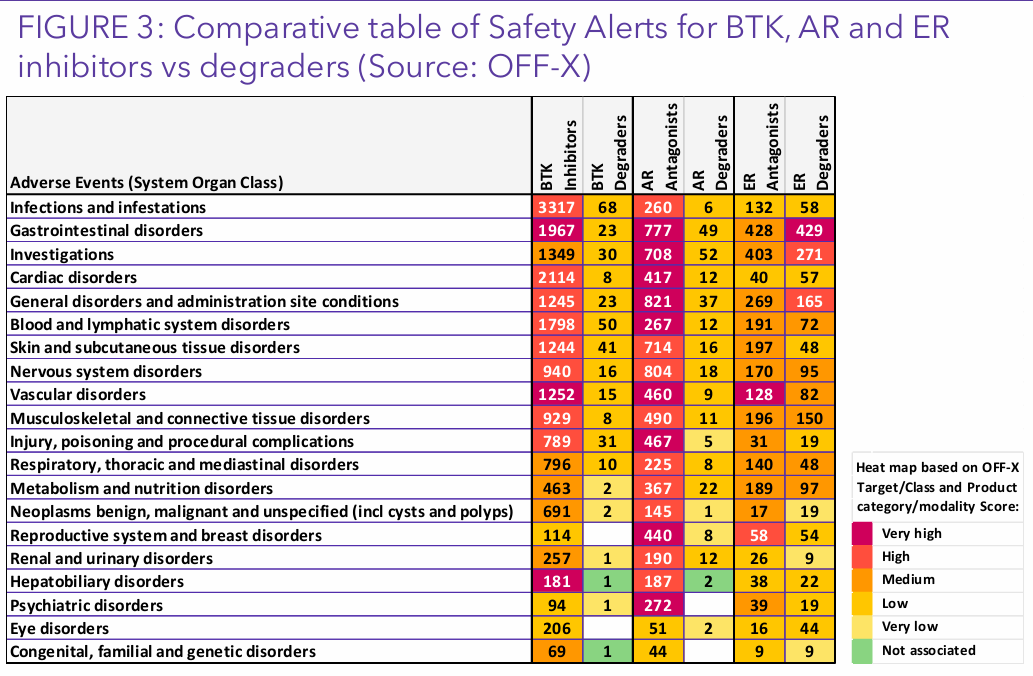
Comparing reported adverse events across inhibitors and degraders provides early insight into how TPD safety may diverge — or align — with conventional pharmacology. Across BTK, AR and ER, many of the most common adverse event categories are shared between degraders and inhibitors. These include hematologic, gastrointestinal and skin‑related disorders, reflecting the underlying biology of the targets rather than modality‑specific toxicity alone.
However, some notable differences are already emerging. For example, BTK degraders have not reported hepatobiliary disorders that are observed with some BTK inhibitors. Similarly, AR degraders have not yet shown psychiatric adverse events reported with AR antagonists. While these observations are encouraging, they should be interpreted with caution given the relatively small patient numbers currently exposed to degraders.
These early signals emphasize an important point for developers: the absence of reported toxicity today does not equate to long‑term safety. As programs advance into larger and more diverse populations, rare or delayed adverse events may still emerge.
Leveraging genetics and biology to anticipate risk
One of the most powerful tools for understanding degrader safety lies outside traditional toxicology studies. Human loss‑of‑function variants and knockout (KO) models — particularly humanized systems — can act as analogues for sustained target degradation. They provide valuable context for understanding what happens when a protein’s function is reduced or eliminated over time.
BTK offers a clear example. Genetic loss of function in BTK, as seen in X‑linked agammaglobulinemia, is associated with profound defects in B‑cell signaling and increased susceptibility to infections. Consistent with this biology, both BTK inhibitors and degraders show elevated risks of infectious adverse events in clinical settings. The convergence of genetic evidence and pharmacological data strengthens confidence that these effects are on‑target and predictable.
Hormone‑activated transcription factors such as AR and ER present a different but equally instructive case. These receptors play central roles in metabolic and reproductive regulation. Degradation of AR or ER has been associated with adverse events such as breast‑related symptoms, altered appetite and metabolic disturbances — again, reflecting known biology rather than modality‑specific surprises.
Designing preclinical safety with TPD biology in mind
For developers advancing TPD programs, these findings underscore the importance of designing preclinical safety strategies that are explicitly informed by target biology, genetics and clinical precedent. Rather than treating degraders as entirely new entities, it can be more productive to view them through a comparative lens—asking where irreversible protein loss might amplify known risks, shift their timing, or introduce new dimensions.
This means integrating evidence from multiple sources: clinical data from inhibitors, human genetic observations, pathway biology and emerging degrader‑specific safety reports. In the analysis described here, adverse event comparisons were enabled using translational safety intelligence, including OFF‑X, to systematically assess inhibitors and degraders across key targets. The value lies in the ability to contextualize safety signals across modalities and biological mechanisms.
Turning insight into action
Targeted protein degradation holds transformative potential, but its success will depend on thoughtful, biology‑driven risk assessment. Early signs suggest that degraders share many safety liabilities with inhibitors acting on the same targets, while also showing areas where toxicity profiles may differ. Large, well‑characterized patient populations will ultimately be needed to define these differences.
For now, the message for drug developers is clear: combining comparative pharmacology with genetic and pathway‑level insight offers a practical way to anticipate safety challenges and guide smarter preclinical decisions.
Explore how translational safety intelligence can support target‑specific risk assessment and help de‑risk novel therapeutic modalities throughout discovery and development: OFF-X preclinical and clinical safety data | Clarivate


