
As AI becomes embedded in IP work, a clearer picture is emerging of what meaningful integration looks like. Earlier discussions highlighted how practice is shifting from speculation about the possibilities of AI deployment toward grounded, responsible use — where governance, explainability and human oversight shape how these tools are applied. What follows is a closer examination of the next stage in that canon: how teams are using AI day to day, what patterns of adoption are taking hold, and how confidence evolves as exposure increases.
This article builds those themes by focusing on the realities unfolding inside IP workflows; where value is material, expectations are maturing and the contours of trust are becoming easier to see.
This piece is the second in a three‑part blog series expanding on insights first published in The Patent Lawyer Magazine, exploring how AI adoption is evolving across the IP landscape.
How AI is reshaping IP practice
The findings of The Evolution of AI in IP report point to a decisive shift from pilot projects to the embedding of AI within IP practice. 85% of respondents now use AI in their workflows, an increase from 57% in 2023.
Adoption, however, is not a proxy for impact. The value of AI depends on how deeply it is integrated and whether outputs meet the evidentiary and expected standards required in each context. Risk tolerance varies: a prior art search, a trademark availability review, and the preparation of a patent application carry very different consequences.
Exposure drives trust and confidence
Behind these adoption rates, confidence correlates strongly with breadth of use. In other words, trust in AI does not develop abstractly; it accrues through exposure. Teams move from skepticism to support when systems prove they can perform reliably across multiple, diverse workflows. Organizations deploying AI across three or more workflows report significantly higher support for continued adoption. Among non-users, skepticism remains high, with detractor rates approaching 70%, likely a reflection of limited exposure to dependable results in practice.
Trust in AI-assisted IP tools develops through repeated exposure, not abstract reassurance. In 2023, discomfort was widespread, particularly among attorneys. Two years later, overall comfort has risen by 21 percentage points, though unevenly. Corporate teams are generally more positive; attorneys remain measured, grounded in professional duty. R&D-adjacent roles are the most optimistic, viewing AI as a Socratic tool to accelerate insight. While causation cannot be confirmed from this survey alone, the breadth of exposure is the strongest predictor of confidence.
Value is stabilizing, expectations are shifting
Some perceived benefits have remained consistent since 2023. Respondents cite automation of manual tasks (51%), productivity improvements (42%) and time savings for higher-value work (41%). This suggests that these have become baseline expectations but are now accompanying more general concerns about explainability, defensibility and governance.
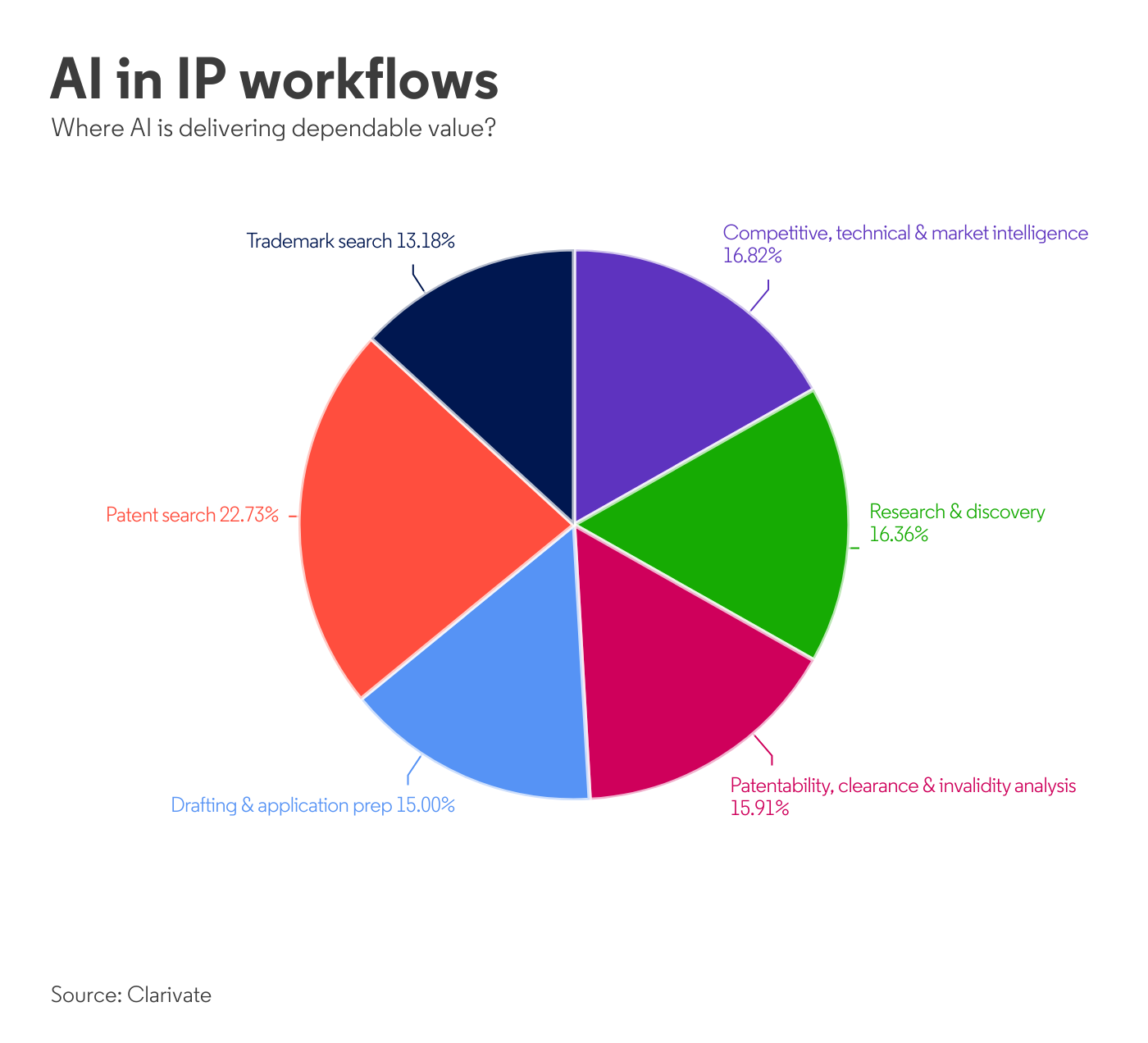
Uptake across functional areas of IP reflects this maturation. What began with routine automation and semantic features for search has now expanded to competitive, technical and market intelligence (37%), research and discovery (36%) and patentability, clearance and invalidity analysis (35%). These areas deal with the highest volume of information and due to their repeatability, AI can enhance efficiency without undermining professional judgment.
Evolving adoption patterns across the IP ecosystem
For practitioners, this clarifies where AI is delivering dependable value and where further refinement and scrutiny is justified. It distinguishes the workflows where AI is genuinely adding value from those where verification burdens still outweigh any purported benefit. These distinctions will quietly shape adoption decisions in the years ahead. They are already visible in usage patterns across the profession.
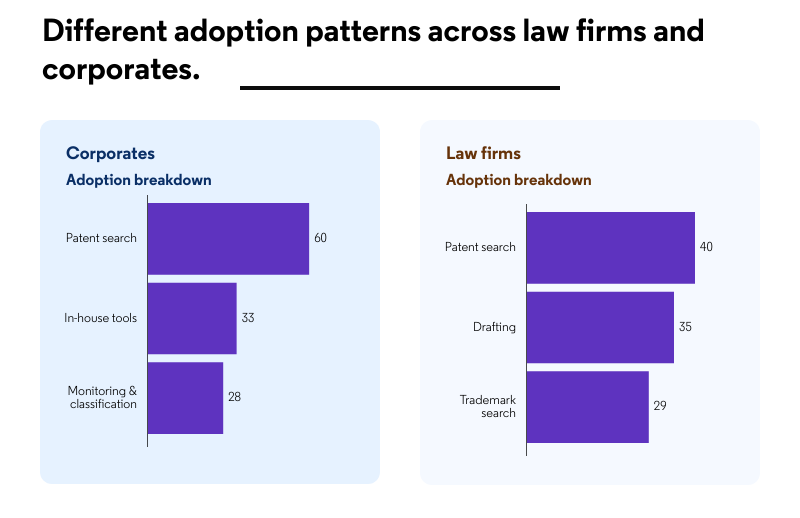
Law firms, for instance, show a distinct profile. Their most cited use case is support for drafting and application preparation at 33%. These tasks require context-specific reasoning and benefit from tools that assist rather than replace attorney judgment. Corporations adopt more broadly across the IP lifecycle, prioritizing:
- Patent search tools at 60%
- In-house capabilities at 33%
- Monitoring and classification tools at 30% and 28%.
Law firms adopt more selectively, focusing on patent search (40%), drafting (35%) and trademark search (29%), balancing innovation with client trust and professional standards.
Another divergence is the gap between general-purpose AI and purpose-built IP tools. Nearly 75% of respondents use platforms such as Microsoft Copilot or ChatGPT, reflecting accessibility, cost and ease of use. Uptake of specialized IP tools is lower, pointing to a mismatch between general AI capability and the precision required for prior art searches, portfolio analytics and structured decision-making. Adoption, in short, is deliberate rather than indiscriminate.
It further highlights the limitations of general-purpose models that sit outside the data, management systems and structures that underpin IP practice; decisions must be traceable, explainable and ultimately defensible.
The direction of travel is clear: not towards more AI, but towards systems and tools that are grounded with domain expertise and embedded within the workflows where decisions are made, and where they must stand up to scrutiny.
The evolution of AI in IP
If you’d like to explore these findings in greater depth, download The Evolution of AI in IP report to see how teams across the IP landscape are integrating AI into their day‑to‑day work.
If you’re considering how to apply AI responsibly within your own IP workflows, you can also speak with a Clarivate expert for AI guidance grounded in real‑world experience.


Related insights
The latest news, technologies, and resources from our team.