What global trademark filings reveal about brand strategy heading into 2026


Using SAEGIS data to understand shifting filing nationalities and where brand protection is headed next, we can see significant changes emerging in global trademark activity. As we wrap up 2025, meaningful movement is appearing in who is filing, where they’re filing and how cross-border protection patterns are evolving. The data tells a nuanced story and offers early signals about how brand owners may adjust their strategies heading into 2026.
In this blog we examine three key trademark filing insights and the implications for intellectual property (IP) teams shaping their 2026 strategy.
1. Applicant nationalities are shifting and driving new filing hotspots
One of the most notable trends emerging from the latest dataset is the redistribution of applicant nationalities across key trademark offices. Several jurisdictions saw notable shifts in their most active filing countries, suggesting brand expansion is evolving in unexpected ways.
In many regions, filings from United States and European applicants remained strong, while several Asian markets saw disproportionate growth in specific Nice classes. For example:
- Mainland China continues to dominate global filing flows, receiving 174,610 foreign trademark applications in 2024 and filing 350,484 applications abroad — more than any country in the world, with the U.S., U.K. and European Union Intellectual Property Office emerging as top outbound destinations.
- Japan illustrates changing dynamics in Asia-Pacific, receiving 26,442 foreign applications in 2024 and filing 47,309 abroad, with Mainland China and the U.S. as key inbound and outbound partners.
- Australia experiencing a 24% surge in foreign filings, reaching 20,936 applications, driven largely by applicants from China and the U.S.
- At the EUIPO, United Arab Emirates-based filings grew 55% year-over-year, surpassing Japan and South Korea and highlighting the expanding global footprint of Middle Eastern brand owners.
The shift in the most active filing countries in these jurisdictions indicates:
- Renewed competition in categories such as tech, pharmaceuticals, consumer goods and AI-driven services.
- Early market testing ahead of product expansion.
- Brand owners prioritizing ‘early mover’ protection in high-growth regions.
For IP professionals, monitoring these changes is becoming increasingly important. As filing nationalities diversify, clearance pathways and risk assessments will require a more global, multi-jurisdictional approach.
2. Foreign vs. domestic filing behavior is changing across key offices
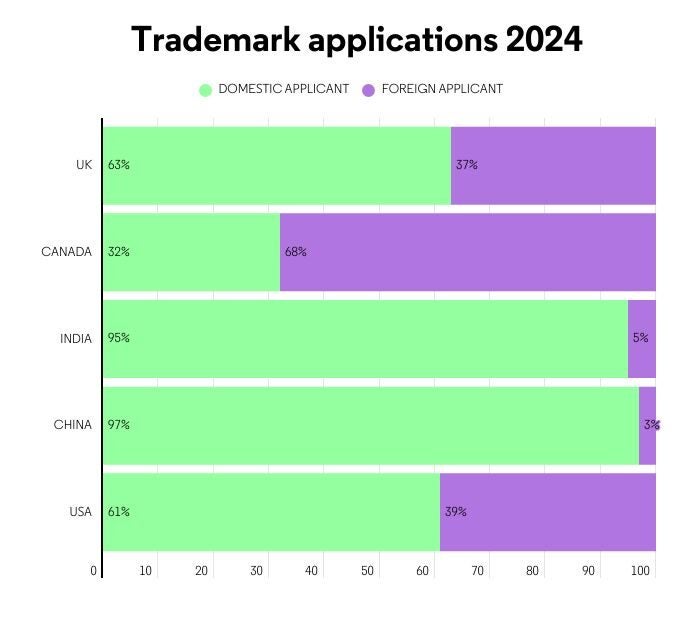
The most recent data also shows meaningful changes in the balance between domestic and foreign applicants at several major trademark offices. In some cases, foreign filings increased even when domestic filings stayed flat or declined. In others, domestic filers are becoming more active, signaling:
- Strengthening local innovation ecosystems.
- Increased regulatory clarity encouraging domestic businesses to formalize early brand protection.
- More sophisticated filing strategies among small and mid-sized enterprises.
Clear examples of these dynamics appear across several high-volume registers:
- India remains one of the most domestically driven markets globally, with more than 537,000 trademark applications in 2024, 95% of which were filed by Indian applicants. Foreign applicants accounted for 23,192 filings, indicating that domestic demand overwhelmingly shapes activity at India’s register.
- Canada’s register is increasingly foreign-driven, with 45,516 foreign applications filed at the Canadian Intellectual Property Office (CIPO) — more than double the number of applications Canadian brand owners filed abroad.
- The U.K. continues to show near parity between inbound (52,977) and outbound (59,909) filings — a balanced profile that underscores its stability.
The Trademark Filing Trends Report offers a comprehensive view of trademark activity across ten major jurisdictions, including the United States, Mainland China, India and the United Kingdom. To gain a deeper understanding of trademark trends, download the full report.
3. Cross-border filing patterns are becoming more concentrated
SAEGIS data also shows a tightening in cross-border filing behavior. While applicants continue to file internationally, they are concentrating their protection efforts in carefully selected jurisdictions rather than pursuing broad, multi-country coverage. Examples supporting this shift include:
- The EUIPO continues to act as a major consolidation point for cross-border protection, receiving more than 149,000 applications in 2024, with Mainland China and the U.S. leading among non-EU contributors. Its single-application model enables brands to streamline protection across 27 markets, reinforcing its role as a central filing hub.
- Representation patterns also signal concentration: Japanese and South Korean applicants prefer filing through German representative firms, creating cross-border ‘channels’ that funnel significant filing volumes through a limited number of intermediaries.
- Canadian brand owners also demonstrate more selective cross-border behavior. While Canada received 45,516 foreign applications, domestic applicants filed far fewer trademarks abroad and focused their outbound activity on just a handful of key destinations — primarily the U.S., the World Intellectual Property Office (WIPO), and the EUIPO. This pattern reflects a concentrated, regionally anchored strategy rather than broad multi-country expansion.
The shift towards a tightening in cross-border filings is reflected in several emerging behaviors:
- More selective portfolio management due to factors likely creating budgetary pressure.
- More targeted go-to-market strategies.
- Greater reliance on analytics to identify ’must-protect’ markets.
- A desire to avoid overextending portfolios amid fast-moving competitive landscapes.
As we move into 2026, this concentration of cross-border filings suggests that brands may increasingly align trademark protection with the jurisdictions most likely to impact revenue, investor interest or long-term growth, rather than relying on broad, legacy filing templates.
What does this mean for IP strategy in 2026?
Taken together, the shifts toward more selective portfolio management, targeted market entry and analytics-driven market prioritization reveal a more disciplined approach to securing trademark rights internationally. For IP teams, the trends highlighted in this analysis point to several strategic adjustments worth considering in 2026:
- Using data to prioritize jurisdictions that matter most.
Concentrated cross-border filings suggest that teams should rely on analytics to identify high-impact markets and avoid overextending portfolios. - Building clearance strategies around shifting filing nationalities.
Changing applicant profiles mean that risk assessments must account for new sources of competition across key trademark offices. - Monitoring competitive activity more closely in priority markets.
Increased foreign or domestic filing activity in specific jurisdictions signals where brand owners may face greater hurdles, and where early monitoring can provide an advantage. - Adjusting filing plans more frequently as patterns evolve.
With nationalities and filing behaviors shifting at different speeds across jurisdictions, annual plans may need mid-year refinement to stay aligned with emerging conditions.
As global trademark activity continues to evolve, access to reliable, up-to-date data — and tools that make it actionable — will be essential for designing and navigating evidence-based strategies.
How Clarivate can help with trademark portfolio strategy
The SAEGIS platform provides unmatched visibility into global filing patterns, applicant nationalities and cross-border activity. With curated trademark data, watch tools and analytics designed for speed and accuracy, IP teams can make stronger filing decisions and build strategies that keep pace with emerging market behavior.
If you’re exploring how filing-nationality trends may affect your clearance plans, we’re here to help.


Related insights
The latest news, technologies, and resources from our team.