DRG Epidemiology Intelligence
Trusted epidemiology intelligence delivering incidence, prevalence, and long-range patient population forecasts to guide confident planning
Reliable, expert curated epidemiology intelligence for confident decisions
DRG Epidemiology Intelligence delivers trusted epidemiology intelligence designed for pharma forecasting and strategy, combining disease incidence and prevalence data, 10–20 year patient population forecasts, and granular segmentation across 1,000+ diseases. Built by a global team of 40+ epidemiologists using transparent, validated methods, it provides a defensible foundation for forecasting, portfolio planning, and clinical strategy.
Epidemiology you can trust and act on

Forecast with confidence, not assumptions
Get defensible epidemiology forecasts with transparent disease incidence and prevalence estimates and 10–20 year population projections built on transparent, Clarivate expert validated models—giving teams the clarity needed to make reliable, evidence-based decisions.

Granular segmentation across 1,000+ diseases
Identify patient populations with precision using advanced epidemiology segmentation across biomarkers, comorbidities, stages, age, and geography—revealing the addressable patient populations behind every opportunity.

Global, consistent epidemiology at scale
Plan globally with confidence using harmonized epidemiology coverage across 170+ countries—giving teams a consistent, comparable foundation for forecast models, portfolio planning, and cross-market decisions.

Deeper U.S. patient insights with Real‑World Data
Leverage U.S. claims based epidemiology to refine population estimates beyond published sources with expanded segmentation by age, gender, ethnicity, and geography. Insights sourced from Clarivate U.S. Real World Data provide national and state level granularity for more precise planning and forecasting.
Two essential tools for precise, defensible epidemiology
Expert curated epidemiology intelligence built to anchor forecasts, market sizing, and evidence based planning.
Incidence and prevalence forecasts
Access fast, reliable incidence and prevalence estimates with 10–20‑year forecasts built on transparent, expert‑validated models across 1,000+ diseases.
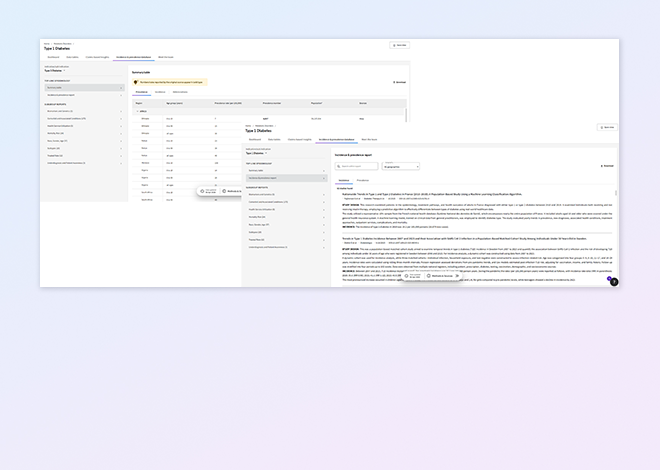
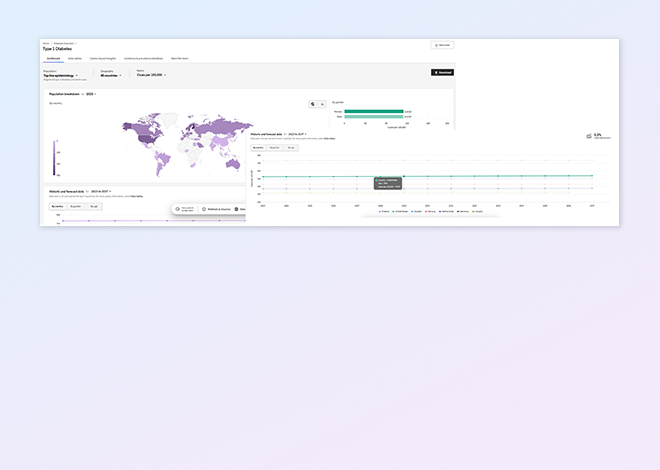
Epidemiology
Quickly size global markets using harmonized epidemiology across 170+ countries, including granular segmentation for rare, niche, and complex diseases validated by a team of 40+ expert epidemiologists.
Questions we help you answer with Epidemiology Intelligence
Epidemiology focused questions that establish the foundation for downstream market and commercial analysis.
- How large is the patient population today—and how will it change over time?
- Which subpopulations, biomarkers, or demographic groups matter most for our opportunity?
- How do incidence, prevalence, and population trends vary across global markets?
- Where do claims‑based insights reveal additional patient segments or unmet population needs?
Why Epidemiology Intelligence?
1k+
40+
240+
10 or 20 year
20+ years
Frequently asked questions
Epidemiology intelligence provides structured, validated insights into disease incidence, prevalence, patient population size, and long term trends. It forms the quantitative foundation for forecasting, portfolio planning, clinical development, and market opportunity assessment.
Public datasets often lack granular segmentation, long‑range forecasting, and validated methodology. DRG Epidemiology Intelligence is built by a global team of epidemiologists, clinicians, and therapy‑area specialists using consistent models, rigorous literature review, and integrated claims‑based insights—providing a defensible, future‑focused foundation for strategic planning.
DRG Epidemiology Intelligence focuses specifically on patient population size, incidence, prevalence, segmentation, and long-range epidemiology forecasts. DRG Market Assessment provides broader commercial and market opportunity analysis capturing quantitative and qualitative data, while Disease Intelligence & Analytics is the broader solution area that brings together multiple disease-level insights. Use DRG Epidemiology Intelligence when a trusted quantitative foundation for forecasting, portfolio planning, and cross-market population analysis is needed.
Estimates and forecasts are updated on a regular cadence to reflect new clinical evidence, disease understanding, demographic trends, and published literature. This ensures teams always have the most accurate, up‑to‑date epidemiology inputs for forecasting, portfolio planning, and strategic decision‑making.
DRG Epidemiology Intelligence provides modeled epidemiology estimates across 170+ countries and territories worldwide, including 45 core markets with more detailed disease insights and 126 additional extrapolated markets. Coverage spans major pharmaceutical markets such as the United States, France, Germany, Italy, Spain, the United Kingdom, Japan, Canada, China, Brazil, and Australia, with regional coverage across North America, Europe, Asia Pacific, Latin America, and the Middle East & Africa. This global, harmonized coverage helps teams compare patient populations consistently across markets and build more reliable forecasts, portfolio plans, and market opportunity assessments.
Models draw on published literature, disease registries, government health datasets, peer‑reviewed research, and—where available—Clarivate’s U.S. Real‑World Data and backed by therapy area experts and epidemiologists. This multi‑source approach ensures forecasts reflect the best available evidence while providing clarity on assumptions, limitations, and regional differences.
Yes. Geographic and demographic segmentation helps teams identify where eligible patient populations are concentrated, which regions offer the best recruitment potential, and how population characteristics align with trial criteria—improving feasibility assessments and site‑selection decisions.
Resources









Seven companies forging new paths in women’s health
Women’s health: from neglect to global investment priority For decades, women’s health has been underfunded and understudied, despite women representing half the global population. Conditions that disproportionately affect women, such…


