Global research collaboration is changing: Key insights from our latest ISI report


Global research collaboration is evolving amid geopolitical shifts, pandemic disruptions, and strategic investments. Our new report reveals rising multilateral partnerships, Mainland China’s growing influence, and challenges for U.S. leadership. Explore data-driven insights shaping the future of international research networks.
International research collaboration has long been a driver of innovation, discovery, and global progress. But the landscape is shifting.
Our latest report from the Institute for Scientific Information (ISI) at Clarivate, Research collaboration in a changing world, explores how geopolitical shifts, pandemic disruptions, and strategic national investments are reshaping international research networks. Drawing on data from the Web of Science Core Collection and InCites, the analysis highlights the rise of multilateral collaboration, Mainland China’s growing influence, and strategic challenges facing the United States. These insights matter for researchers, institutional research offices, and policy and funding decision makers worldwide.
Multilateralism on the rise
One of the most striking trends in our data analysis is the shift from bilateral to multilateral collaboration. Countries like the United Kingdom and Germany now conduct more of their international research through multilateral partnerships, with bilateral co-authorship now accounting for less than 50% of their collaborative output. The United States and Mainland China still rely mainly on bilateral partnerships, at 61% and 72% respectively, but this is declining.
Mainland China’s expanding influence
Mainland China has become the world’s most prolific research publisher, with output rising from 26,200 papers in 2000 to over 878,000 in 2024. Its international co-authorship has grown from 6,000 to more than 163,000 papers over the same period.
While collaboration with Western economies dipped between 2021 and 2022, it has since rebounded. Mainland China’s collaboration with Germany, Australia and especially the U.K. has recovered to pre-2021 levels, but this is not the case for Canada and especially the U.S. Notably, Mainland China’s partnerships with countries in the Middle East and Asia – including Iran, South Korea, and Saudi Arabia – showed resilience during this period, suggesting a strategic pivot toward emerging regions.
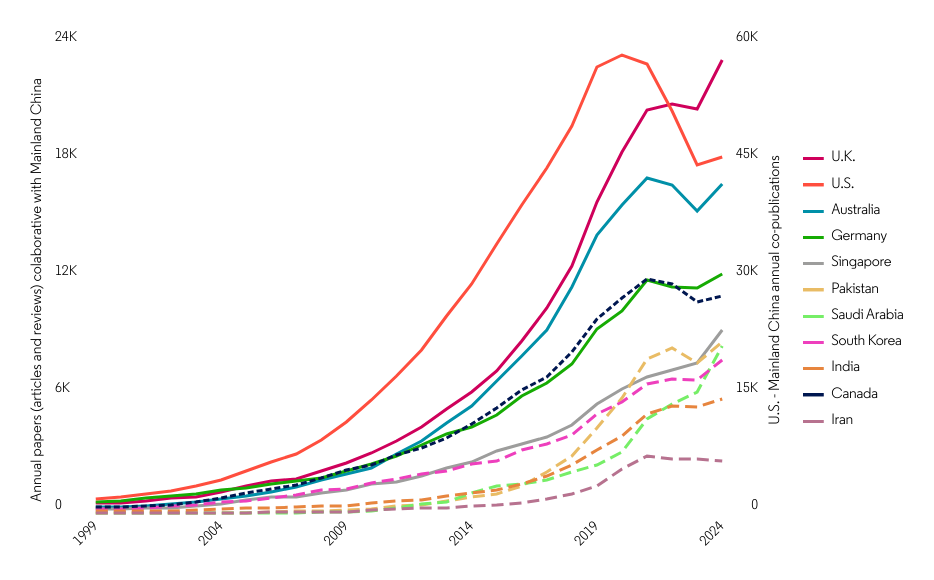
Annual count of research papers (articles and reviews) co-authored with Mainland China. Note that counts of U.S. collaborative publications with Mainland China are plotted on the right-hand vertical axis whereas all other countries are plotted on the left.
Mainland China’s outreach is also evident in regional growth data; co-authorship between Mainland China and countries in Africa, Asia-Pacific, and the Middle East is expanding faster than the underlying regional research growth. For example, Mainland China’s co-authored output in the Middle East grew by a factor of 2.76 between 2015–2019 and 2020–2024, compared to a regional growth rate of just 1.67.
The U.S. at a crossroads
The United States has historically led global research, but recent trends suggest a strategic inflection point. U.S. output is declining, and its share of global collaboration is shrinking. Co-authorship with most partners dropped sharply between 2021 and 2022, with collaboration with Mainland China falling even earlier — from 2019 onward.
Policy decisions have played a role. Restrictions on foreign collaboration and reduced funding for key areas like mRNA vaccine development risk isolating the U.S. from the global research ecosystem. Yet, continued co-authorship with Mainland China has helped sustain U.S. output and impact in several fields, including engineering and health sciences.
Collaboration drives impact
It’s important to consider the relative impact of research outputs. Using Category Normalized Citation Impact (CNCI), we found that collaborative papers consistently outperform domestic-only publications. The CNCI of Mainland China–EU27 papers now exceeds that of U.S.–EU27 collaborations, reflecting a shift in research excellence. Mainland China–EU27 papers now exceed that of U.S.–EU27 collaborations, reflecting a shift in research excellence.
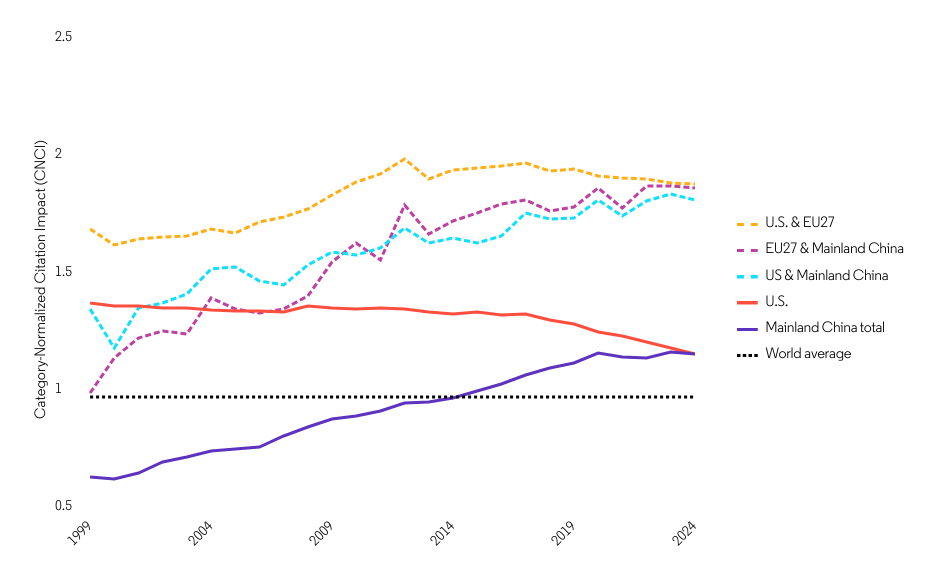
Annual Category Normalized Citation Impact (CNCI) of papers (articles and reviews) authored and co-authored by Mainland China, the United States and the European Union. Collaborative papers are almost always cited more frequently than domestic papers.
Mainland China’s CNCI has risen steadily over the past 15 years while the U.S. average has declined, and they are now similar. The CNCI of their joint papers is higher than the overall U.S. average, underscoring the continuing value of international partnerships – and the risks of disengagement.
Strategic implications
For research professionals and policymakers, the report’s findings carry important implications:
- Universities should prioritize multilateral partnerships and monitor CNCI trends to assess the impact of collaborative outputs.
- Funders must recognize the growing importance of emerging economies and support inclusive, high-impact collaboration models.
- Policymakers should balance national security concerns with the need for open scientific exchange, especially in critical and emerging technologies.
Looking ahead
The global research system is in flux. Mainland China is expanding its influence through strategic partnerships, while the United States faces challenges to its leadership role. Collaboration remains the cornerstone of high-impact research — and those who embrace its evolving forms will be best positioned to lead in the years ahead.
As we move forward, it is essential to maintain a clear-eyed view of the data and to support policies that foster openness, excellence, and global engagement. The future of research depends on it.
Download here to read the full report.


Related insights
The latest news, technologies, and resources from our team.