
Web of Science is evolving to help researchers search, explore, and work with trusted literature in more flexible, transparent, and AI-supported ways.
AI is reshaping how researchers discover and work with scholarly information. Questions that once required hours of searching can now be answered in seconds. Yet speed alone is not enough.
Research demands something deeper: transparency into how responses are generated, confidence that insights are grounded in trusted scholarly sources, and the ability to retain control over search methodology when precision and reproducibility matter. And a researcher beginning work in an unfamiliar field has different needs from one conducting a systematic review. Someone exploring broad trends requires a different experience from someone evaluating the evidence in an individual paper. No single approach is right for every research task.
That reality is shaping the future of Web of Science. We have carefully considered where AI can reliably enhance the research process, then built distinct but connected experiences that employ AI differently — or not at all — to support varied needs. Whether the goal is rapid orientation, precise retrieval, deeper exploration, or evidence analysis, researchers can choose the approach that best fits their work while remaining grounded in trusted scholarly content.
When you need to get oriented quickly
For a researcher moving into an adjacent field, a student narrowing a thesis topic, or a team exploring an emerging area of research, the challenge is understanding the landscape.
Web of Science Smart Search is designed for those moments. Researchers can ask questions naturally, explore relevant literature even when terminology varies, and quickly identify key concepts, influential papers, researchers, and institutions. Within this experience, AI Overviews help surface the major themes and trends represented within a result set, allowing researchers to understand where to focus next before diving deeper. We are also developing a Search Assistant that will offer guided query refinement, helping users narrow or broaden a search and understand what changed as they iterate.
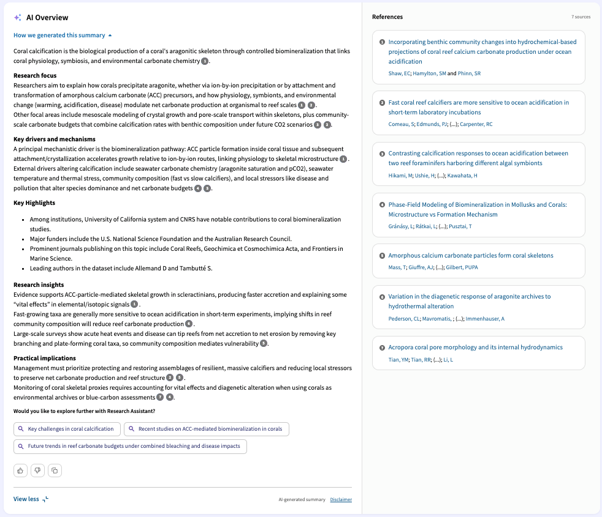
Figure 1: AI overviews in Web of Science search results
When precision matters
AI can accelerate many aspects of discovery, but some research tasks demand complete transparency, precision, and reproducibility. In systematic reviews, evidence syntheses, and other rigorous research workflows, researchers need to understand exactly what was searched, why results were returned, and how a query can be repeated.
Advanced Search is designed for these situations. Researchers can define exactly which fields and terms to query and what to include or exclude, maintaining full control over the search process so it can be documented and repeated. We are also developing tools that will help researchers construct sophisticated Boolean searches more easily, while preserving researcher oversight of the final query. AI can help with the mechanics, but researchers will retain control over the search that is executed.
When you need help turning information into understanding
Discovery is essential, but it is only one step in the broader research process. Once researchers have identified relevant literature, they need to understand how ideas connect, evaluate evidence, identify trends, and decide where to focus next.
Web of Science Research Assistant supports exploration and interpretation with agentic AI, helping researchers investigate topics, develop literature reviews, understand author influence, uncover relationships, and work toward specific research goals. An extended Research Assistant experience also connects literature discovery with research intelligence, helping users explore funding opportunities and prepare grant proposals.
Planned enhancements continue to add depth and context. Deep Search will mirror the way researchers investigate a topic from multiple angles, combining rephrased Boolean and semantic searches, foundational studies, co-author networks, and citation patterns into a referenced report that considers sub-themes, areas of debate, and the strength of supporting evidence. Manuscript upload will give researchers a way to bring their own work into the experience so they can identify relevant references they may have missed, uncover supporting or contrasting literature from Web of Science Core Collection, and discover gaps or perspectives that may not yet be reflected in their draft.
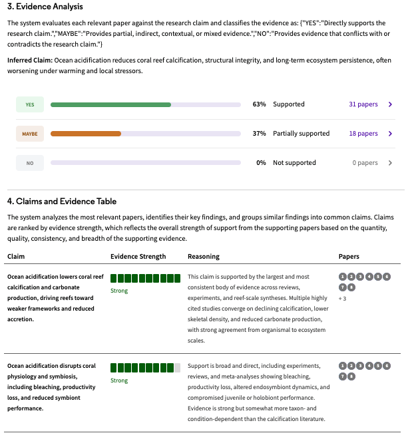
Figure 2: Selected sections of a full Deep Search report in Web of Science Research Assistant
Looking ahead, DeepR will extend these capabilities further by bringing full-text content and document-level AI assistance into the research workflow. Researchers will be able to work directly with scholarly documents through capabilities such as the embedded PDF Reader and Document Assistant, helping bridge the gap between discovering relevant literature and engaging deeply with the evidence itself. As DeepR becomes available across the platform, it will strengthen the connected experience that links discovery, exploration, and analysis.
Responsible AI means providing choice
As AI becomes more common in research, responsible design matters. For Web of Science, that means capabilities that are grounded in trusted data, designed for transparency, applied deliberately, and led by human expertise.
- Grounded in trusted data: AI capabilities are built on trusted Web of Science data, providing a foundation in curated scholarly content.
- Designed for transparency: We aim to provide researchers with visibility into how an output or result was produced.
- Applied deliberately: AI is introduced where it adds value, rather than becoming a mandatory layer across every task
- Led by human expertise: AI supports discovery and analysis rather than substituting for researcher judgment.
Helping researchers do more with trusted literature
Researchers don’t all work the same way, and research rarely follows a linear path. Scholars need different levels of assistance, transparency, and control depending on the task at hand.
That’s why Web of Science is evolving as a connected ecosystem of discovery experiences. Our goal is to help researchers move confidently from finding information to understanding it, analyzing it, and acting on it. Rather than forcing every research task into a single experience, we’re giving researchers the flexibility to choose the approach that best fits the work in front of them.
Explore new search and discovery features in the Web of Science.


Related insights
The latest news, technologies, and resources from our team.