Understanding the societal impact of research: From framework to practice


Measuring the societal impact of research is increasingly important. This article explains how the Clarivate Societal Impact Framework, developed by the Institute for Scientific Information and implemented in Web of Science Research Intelligence, supports more responsible, transparent analysis by combining structured categorization, diverse data sources and clear guidance on interpretation.
Evaluating the societal impact of research poses many challenges: societal needs are diverse, there is no “one size fits all” approach, impacts often take years to emerge, and meaningful assessment requires balancing qualitative and quantitative data. These challenges make it difficult for institutions to move beyond relying on isolated metrics to using data-driven, comparable analyses that can credibly inform assessment, strategy and decision making.
The Institute for Scientific Information (ISI) developed the Societal Impact Framework in 2024 to address these challenges. Our latest report, Clarivate Societal Impact Framework: A guide to responsible impact measurement, explains how this structured yet flexible Framework organizes diverse signals of societal impact, supports consistent but adaptable categorization, and embeds guidance on interpretation to reduce the risk of over‑simplification or misuse.
Drawing on best practices from research assessment exercises (RAEs) and other evaluation frameworks, and grounded in ISI expertise in responsible research assessment, the Framework introduces features such as SDG-driven categorization, a clear distinction between signals of potential and observed impact, and responsible data aggregation within Societal Impact Profiles.
Clarivate has implemented the Framework within Web of Science Research Intelligence, addressing another persistent challenge: access to verifiable, comparable data from diverse sources at scale. By bringing together high-quality, publisher neutral data with explainable analytics, this new platform helps institutions analyze the societal impact of their research with greater confidence. In this context, they can use the Framework to support more informed, responsible analysis and decision making.
Designing the Societal Impact Framework responsibly
ISI shaped the development of the Societal Impact Framework around key design principles intended to create a structured, transparent and adaptable tool for societal impact evaluation.
Its structure is global in scope but flexible by design. The Framework provides a consistent way to organize societal impact data while allowing users to adapt that structure to their own assessment needs. For example, its default impact categorization aligns with United Nations Sustainable Development Goals (SDGs), while users can define their own classifications.
It provides multiple levels of granularity. Users can view the same data at institutional or project level, depending on the question they are asking, with appropriate context provided at each level, such as the size of an institution or project, and baselines for relative comparison. The Framework combines verifiable data from diverse sources to reinforce transparency over black-box approaches.
Finally, ISI designed the Framework to work alongside additional data sources, including institutions’ own internal data, to support a more complete view of the societal impact of their research.
What makes the Framework unique
The Societal Impact Framework takes a structured approach to categorizing societal needs and impact signals, helping institutions and researchers make sense of impact through a set of core features:
- The Framework uses the SDGs as its default categorization, linking research outputs and outcomes to global societal challenges and aligning with many evaluation approaches and RAEs through PESTLE-based aggregation.
- A layered mapping of outputs and outcomes to societal needs allows institutions to apply their own impact categorization systems, supporting use across global, national and regional research assessment contexts.
- Societal Impact Profiles (Figure 1, Figure 2) summarize overall performance across societal facets, providing a starting point for exploring underlying data, metrics and indicators and supporting more transparent, granular analyses.
- The Framework distinguishes between signals of potential impact (forward-looking indicators) and signals of observed impact (retrospective indicators), helping users understand how impact develops over time.
- Quantitative indicators are complemented by qualitative indicators to provide a more rounded view of the societal impact of research.
- The Framework works across a wide range of data types, including academic publications, patents, clinical trial data and policy documents. Its implementation within Web of Science Research Intelligence provides a breadth and depth of data unique to Clarivate.
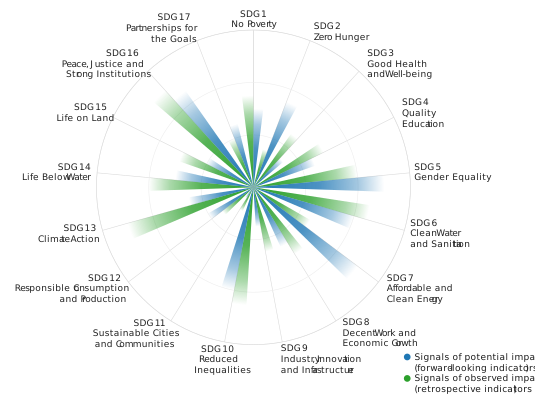
Figure 1: Example Societal Impact Profile showing the general trend in the signals of potential and observed impact over the 17 UN Sustainable Development Goals
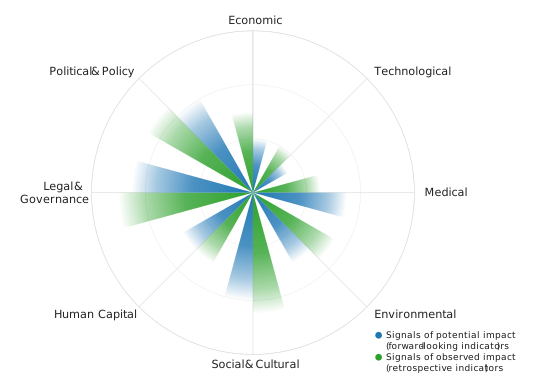
Figure 2: Example Societal Impact Profile showing the general trend in the signals of potential and observed impact over the eight societal facets
What responsible use looks like in practice
Through the Societal Impact Report in Web of Science Research Intelligence, research offices can apply the Framework to a wide range of use cases, including preparing, writing and validating case studies for national research assessment exercises. It allows institutions to align with local requirements by applying custom impact categorizations, integrating institutional data, using national benchmarks, and identifying the relevant underpinning outputs to strengthen impact case studies.
The report provides important guidance on using the Framework responsibly to support effective analysis and decision making:
Use indicators as signals, not proof. No single metric fully captures the societal impact of research. For example, patent citations or media mentions reflect aspects of impact, but they do not provide definitive evidence of its full extent.
Consider both observed and potential impact. Assessing only observed outcomes, such as policy citations, provides a limited view. Forward-looking indicators — relevance, communication, engagement, and collaboration — help contextualize how impact develops over time.
Interpret data in context. Numbers alone are rarely informative. For example, citation counts are only meaningful when taken in context and compared against appropriate benchmarks at national, regional or global levels. The Framework enables these contextual comparisons.
Account for data limitations and uncertainty. Some indicators are sparse or uneven across disciplines. Small numbers may not be statistically significant. Thresholds and relative positioning help, but users should avoid overinterpreting limited data.
Compare like with like. Ensure comparisons are meaningful — for example, generalist institutions with generalists, or subject specialists with other specialists in the same field.
What this means for the research community – and what comes next
Responsible measurement does not mean measuring everything, nor reducing impact to a single score. It means choosing appropriate signals, interpreting them with care, and using them in ways that support analysis and decision making.
The Clarivate Societal Impact Framework provides a structured yet flexible way to do just that. We will continue to refine the Framework, expand data sources, and incorporate feedback from users and the wider research community.
We invite you to read the report, explore the societal impact content in Web of Science Research Intelligence, and share your feedback as we continue to develop responsible approaches to understanding the societal impact of research.
Read our report: Clarivate Societal Impact Framework: A guide to responsible impact measurement, and learn more about Web of Science Research Intelligence


Related insights
The latest news, technologies, and resources from our team.