Solar technology is evolving rapidly, with perovskite emerging as a key enabler of a sustainable energy future.
Carbon neutrality and energy transition have become essential goals worldwide. As countries shift away from fossil fuels, renewable energy is gaining importance. Among these, solar power is growing the fastest thanks to its scalability, cost efficiency, and technological progress.
Perovskite Solar Cells (PSCs) are attracting attention for their strong light absorption, lower manufacturing cost, and rapid development. Once lab-only material, PSCs have reached 27.3% efficiency in just over a decade, making them one of the most promising next‑generation solar technologies.
Global research competition around perovskite solar cells is intensifying as worldwide attention continues to grow.
Sungkyunkwan University (SKKU) utilizes our research intelligence solutions to enhance the accuracy and depth of its analysis of global perovskite solar cell trends. This partnership supports SKKU researchers in benchmarking global performance, identifying emerging topics, and accelerating high‑impact scientific contributions. Building on this collaboration, Professor Nam-Gyu Park’s team at SKKU in South Korea analyzed global research trends using the Web of Science Core Collection by Clarivate, focusing on “Perovskite Solar Cell” as the primary keyword for articles and reviews published between 2010 and 2025. Data processing and citation metrics were derived from the InCites Benchmarking & Analytics platform, reflecting data as of May 2025.
Yoo-Jin Park, Manager, Office of Performance Analysis, Sungkyunkwan University , said: “By leveraging Web of Science and InCites in combination with data analysis tools such as Python, we were able to systematically analyze research trends in perovskite solar cells. Collaboration with Clarivate, a global leader in research analytics, has been instrumental in enhancing the quality of this report and shaping insights into future research directions.”
Key findings:
- Research activation
Perovskite solar cells have emerged as a next‑generation technology that combines technological differentiation based on a new light‑absorbing material with complementary characteristics to the existing photovoltaic industry. Global interest has surged, as evidenced by research output: the number of PSCs-related publications grew from just 4 in 2012 to 6,130 in 2024—a nearly 1,500-fold increase in 13 years.
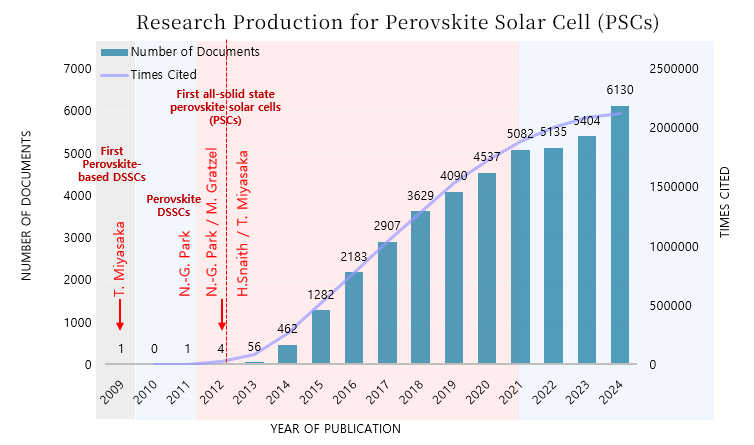
Source: Web of Science, and Park, N. G. Methodologies for high efficiency perovskite solar cells. Nano Converg. 2016, 3, 1-13.
As global attention to carbon neutrality intensifies, demand for eco-friendly energy has risen. Research aimed at improving power conversion efficiency and stability through multi-junction technology continues to progress. Consequently, competition among nations and institutions to lead PSCs technology has accelerated, and research activity is expected to become even more dynamic.
- Research performance in countries and regions
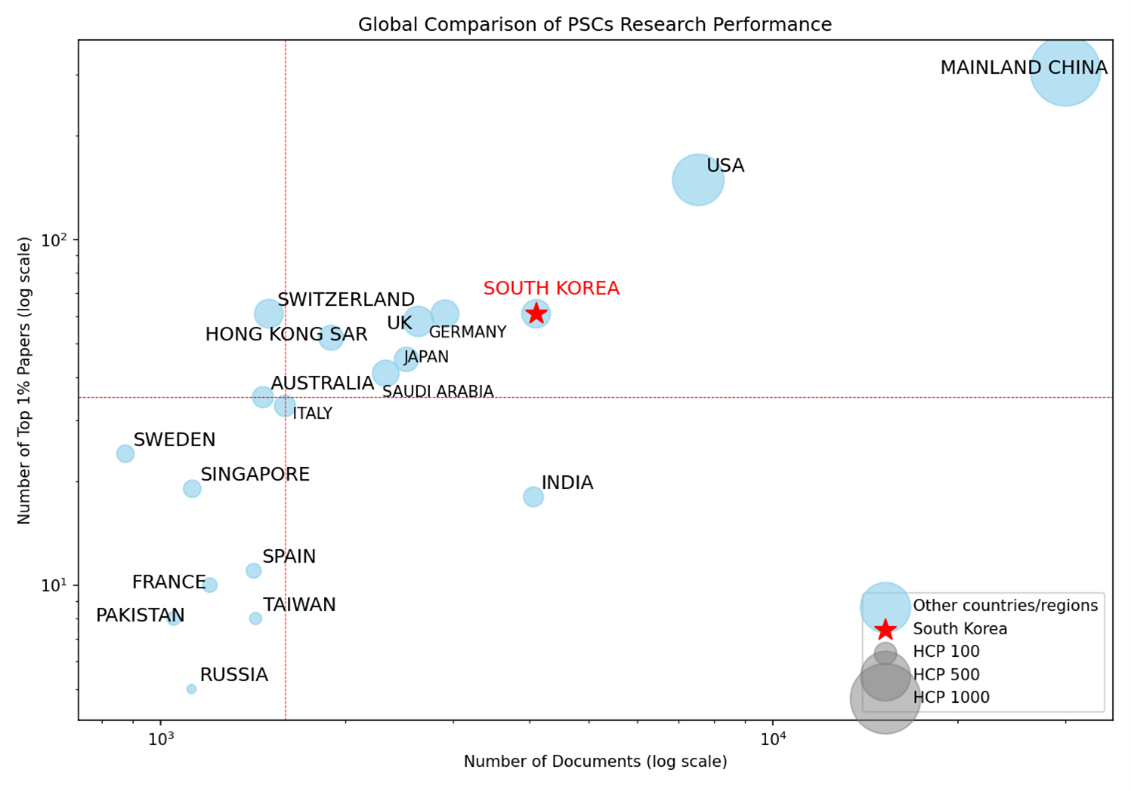
An analysis of research competitiveness over the past decade (2016–2025) shows that Mainland China, the United States, and South Korea lead in publication volume, followed by India, Germany, and the UK. In terms of Highly Cited Papers (top 1%), Mainland China, the US, and South Korea rank first, second, and third respectively.
Leading researchers worldwide are driving innovation and shaping the global impact of perovskite solar cell research.
Since 2010, PSCs technology has rapidly advanced in power conversion efficiency (PCE), positioning itself as a promising next-generation solar technology. Over the past 15 years, leading researchers worldwide have driven this progress, influencing both efficiency improvements and industrial adoption.
- Henry Snaith (Oxford University): A globally influential researcher whose work laid the foundation for modern perovskite technology, and co‑founder of Oxford PV, which is accelerating commercialization.
- Michael Graetzel (EPFL): Introduced the concept of dye-sensitized solar cells (DSSC), laying the foundation for PSCs research.
- Nam-Gyu Park (Sungkyunkwan University): Developed the first all-solid-state PSCs and ranks 4th globally in research impact. He received the Eni Award in 2024 and is frequently mentioned as a Nobel Prize candidate.
Perovskite solar cells represent more than material innovation—they are reshaping the energy industry paradigm. Over the next decade, this technology is expected to expand beyond solar applications to space exploration, unlocking limitless possibilities.
For more information, please download the report.


Related insights
The latest news, technologies, and resources from our team.