Scholarly impact and societal relevance: how Highly Cited Researchers contribute to United Nations Sustainable Development Goals


An analysis of Clarivate’s 2025 Highly Cited Researchers shows that more than 75% of their Highly Cited Papers align with at least one United Nations Sustainable Development Goal (SDG). This suggests a strong, though uneven, link between citation impact and societal relevance.
Clarivate’s annual list of Highly Cited Researchers, numbering 6,868 individuals in 2025, represents a large cohort of influential researchers whose work spans multiple specialty areas in the sciences and social sciences. Between 2014 and 2024, they published around 55,000 Highly Cited Papers – articles and reviews that ranked in the top 1% by citations for their field and publication year and met the program’s evaluation criteria.
As interest grows in how publicly funded research benefits society, these Highly Cited Papers help us explore whether scholarly impact, of which citations are one important indicator, also aligns with wider societal goals. One useful framework for this is the United Nations 17 Sustainable Development Goals. A new interactive dashboard by the Institute for Scientific Information (ISI) enables users to explore how the world’s most influential research maps to the SDGs across disciplines and countries/regions, providing key insights into the societal relevance of research published by Highly Cited Researchers.
How global highly cited research aligns with SDGs
More than 75% of the papers in our analysis can be associated with one or more SDG. On average, a paper has two to three SDG assignments but not all research papers will be mapped to SDGs. For example, fundamental research in astrophysics or mathematics are often focused on expanding new knowledge rather than immediate social benefit. Even so, some surprising contributions have descended from fundamental science, such as charge-coupled devices from astronomical research and data compression technologies from theoretical mathematics and wavelet studies.
This 75% of Highly Cited Papers also represents a higher alignment to SDGs, when compared with the share of all other papers outside of this set aligned to goals, suggesting that scholarly impact is correlated with societal relevance.
How alignment varies across different Sustainable Development Goals
The new dashboard also explores how the 2025 Highly Cited Researchers’ corpus of influential publications and their associated subject categories are related to different SDGs.
Figure 1 reveals the distribution of this 75% of Highly Cited Papers that can be mapped to one or more SDG.
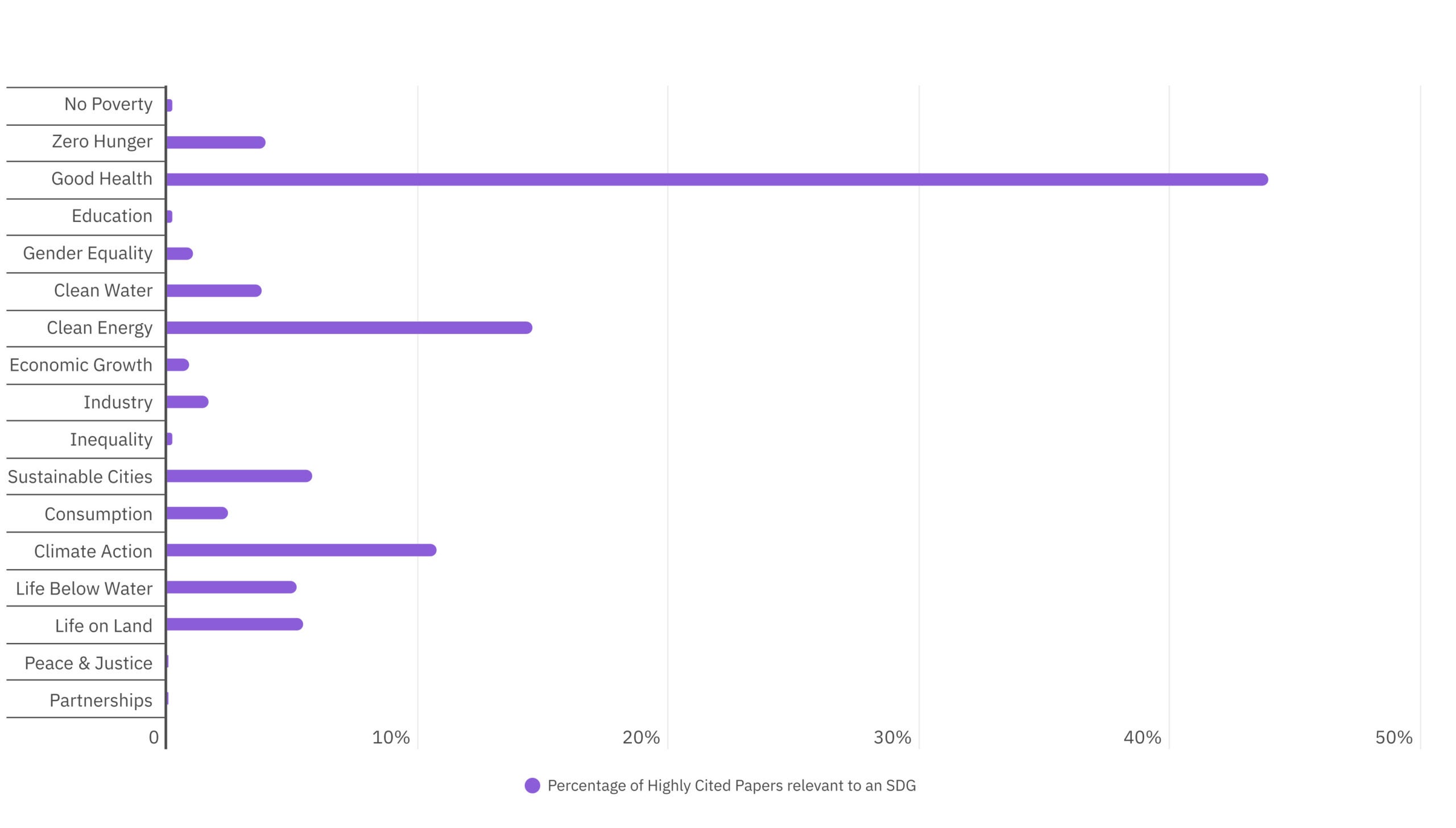
Figure 1. Distribution of Highly Cited Papers by SDG
Highly Cited Papers are associated with some SDGs much more than others. Good Health, Clean Energy, and Climate Action have a strong connection and dependence on research, while Inequality, Peace & Justice, and Partnerships show a weaker association with scholarly contributions, at least as represented by the Highly Cited Papers. This is explained in part by the higher volume of traditional scholarly publishing in the life sciences and natural sciences, less likely to be linked to these goals, as well as by the fact that many societally relevant contributions in the social sciences take forms other than journal articles, such as policy documents, governmental reports, or NGO publications.
For each Highly Cited Researcher subject category, the dashboard also reveals interesting, and not always obvious, insights into the societal needs addressed by influential scholarly research in that field. For example, Highly Cited Papers in Mathematics are strongly oriented towards challenges related to Good Health, Highly Cited Researchers in Physics focus predominantly on Clean Energy challenges, while Computer Science research addresses the needs of Sustainable Cities and, again, Good Health.
Interpreting the relationship between citation impact and societal outcomes
Understanding the relationship between highly influential research and societal benefit is complex, and it varies by field, geography and timeframe. The UN Sustainable Development Goals provide a useful framework for this analysis, but meaningful interpretation still requires careful review of the underlying data and an understanding that real-world impact may take years or even decades to emerge. This dashboard offers a starting point for exploring those connections, while advances in data, methods and tools are making it increasingly possible to assess how scholarly impact relates to progress on global challenges.
Explore our interactive dashboard to understand how the world’s most influential research aligns to global societal challenges.
Learn more about the Clarivate SDG classification schema and how SDGs are used to assess the societal impact of research in our report on the Clarivate Societal Impact Framework and its implementation in Web of Science Research Intelligence.


Related insights
The latest news, technologies, and resources from our team.