
As the Unified Patent Court (UPC) moves through its second year, the emerging data paints a clearer picture of how Europe’s new patent litigation forum is maturing. Beyond filing trends and forum activity, one of the most strategically revealing indicators is how divisions are handling requests for preliminary injunctions to stop infringement (PIs), a key test of both procedural speed and judicial philosophy.
These early data patterns illustrate meaningful differences in both grant rates and decision speed, which may shape how patentees weigh the value of fast action versus higher success odds.
The state of preliminary injunctions to stop infringement at the UPC
Over the first two years, Local and Regional Divisions considered 59 PI applications. Excluding cases that were withdrawn, settled, closed or still pending, 41 decisions were issued. The outcome of those decisions among the applications decided over two years was as follows:
- Granted 39%
- Partially granted 14.6%
- Not granted 46.3%
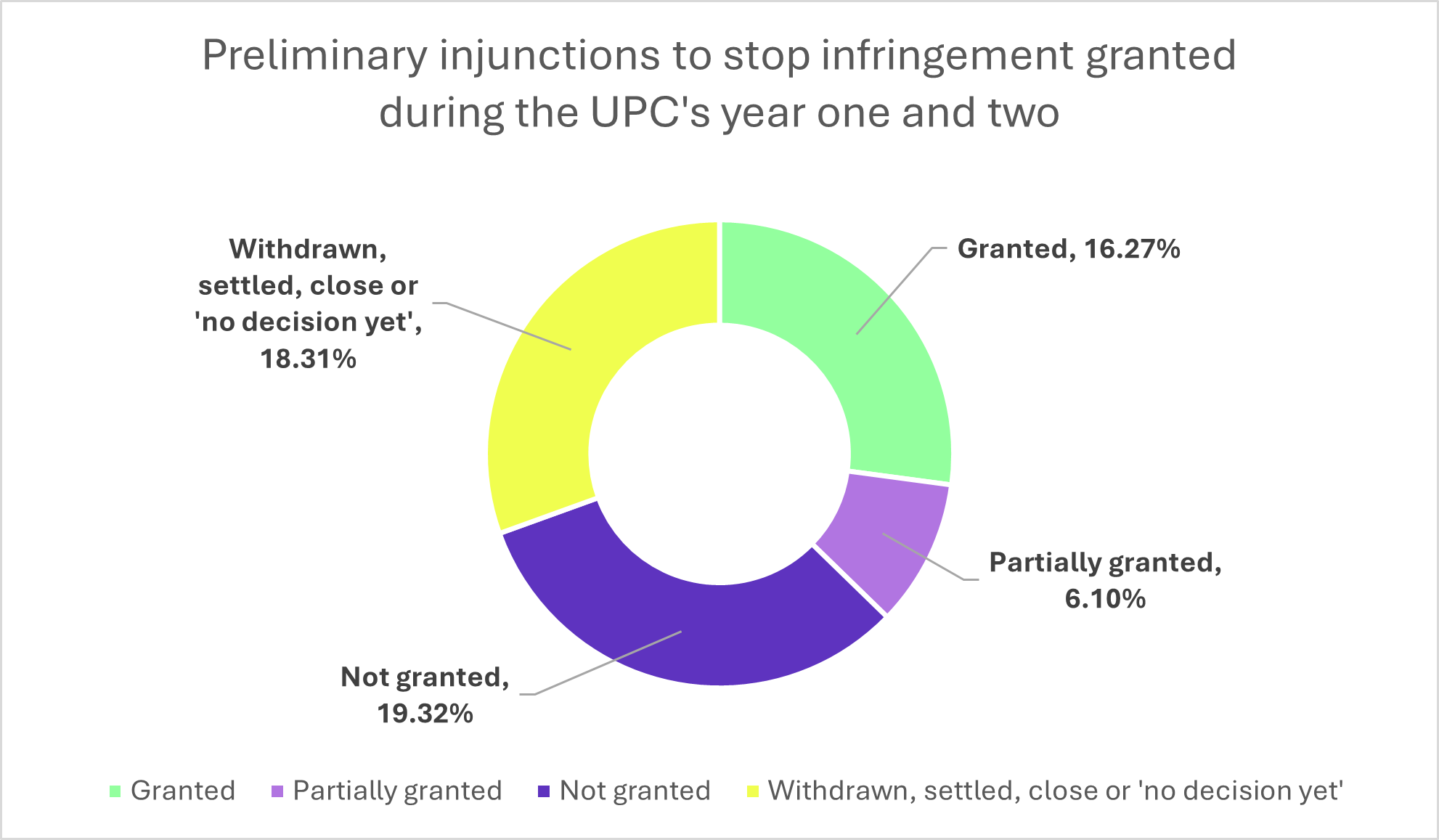
Figure 1. Preliminary injunctions to stop infringement granted during the UPC’s Year One and Year Two
As illustrated by Figure 2, PI outcomes at the UPC are fairly stable year over year. Overall grant rates among the applications decided increased (35% in Year One compared to 42.9% in Year Two) suggesting that the court’s approach to granting injunctions has become more patentee-friendly. Since there is not a dramatic change in the partial grants, non-grants followed an opposing trend and fell from 50% to 42.9%.
Taken together, these results show that while the UPC remains selective about granting full injunctions, it is increasingly willing to issue tailored or conditional relief, perhaps signaling growing confidence among divisions as they refine their standards for urgency, infringement likelihood, and validity at this early stage of the court’s life.
| Decision | Year one | Year two | Increase/decrease | % change |
| Granted | 35% | 42.86% | +7.86% | 28% |
| Partially granted | 15% | 14.29% | -0.71% | 0% |
| Not granted | 50% | 42.86% | -7.14% | -10% |
Figure 2. Decisions before the UPC in year one versus year two.
Grant rates diverge: Where patentees find more favorable forums
At the division level, grant rate outcomes from Years One and Two vary sharply, with Munich being the most favorable and Hamburg the most conservative:
- Munich Local 55.6% granted 11.1% partial
- Düsseldorf Local 33.3% granted 33.3% partial
- The Hague Local 33.3% granted 33.3% partial
- Hamburg Local 28.6% granted 14.2% partial
With two-thirds of PI requests at least partially granted, Munich continues to offer the most favorable environment for patentees seeking urgent relief. Interestingly, pre-UPC national court data (2020-2025) show much higher PI grant rates in Germany (Dusseldorf LG: 65.8%, Munich LG: 70.5%, Hamburg LG: 83.3%), indicating that the UPC is setting a higher bar for PI overall.
As seen in Figure 3, the most common reasons for denial across all locations include “no (apparent) infringement” and “right is not (apparently) valid,” with a handful of decisions citing urgency, balance of interests, or lack of imminent danger.
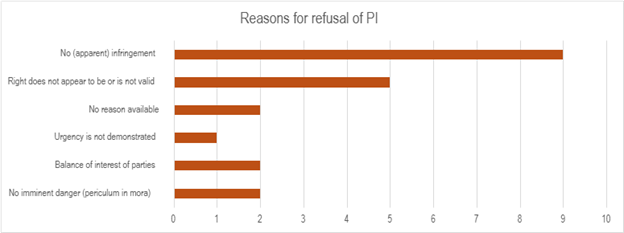
Figure 3: Reason for refusal of preliminary injunction to stop infringement during the UPC’s year one and year two.
Speed matters: The Hague leads while Munich lags behind
While the UPC continues to establish its procedures, the data reveals that the pace of decision-making remains uneven. Variability between local divisions suggests that efficiency gains are not yet consistent across the system. Some divisions are processing cases in record time, while others are still adjusting to caseload growth and procedural complexity. Per Figure 4, the shortest PI proceeding is found before The Hague (median duration of 91 days), while the longest is before Munich (median duration of 143 days). In practice, this means that proceedings before The Hague (and Hamburg) tend to conclude roughly one month faster than those in Munich and two months in Dusseldorf.
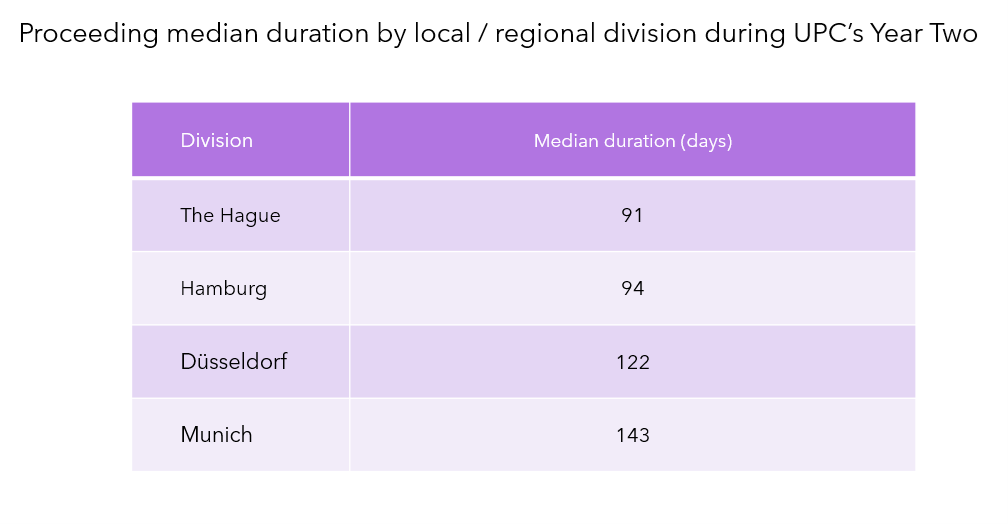
Figure 4. Proceeding median duration by local / regional division during UPC’s Year Two
For claimants and defendants alike, this means that forum selection continues to play a significant role in determining how quickly an application for PI reaches an outcome. The difference of several months between divisions can translate into major strategic and financial impacts.
Strategy in motion: choosing between speed and grant likelihood
The real-world implication revealed by this litigation data is highly strategic: when timing is critical, such as in active product launches or imminent market entries, The Hague remains the go-to venue for fast resolution. Conversely, when the objective is maximizing the likelihood of success, Munich offers the highest PI grant rate to date. In other words, patentees should weigh early merits outcomes in parallel: while Munich’s speed may lag, its relatively patentee-friendly stance may justify the trade-off in some cases.
Methodology
This analysis covers UPC litigation from June 1, 2023, to May 31, 2025, using data from the Darts-Ip patent litigation database. PI statistics are based on the complaint date of the application for the PI.
About the authors
Eric Sergheraert
Eric is a Doctor of Pharmacy (PharmD) and a Doctor of Law (Phd) and holds the certificate of aptitude for the profession of lawyer (CAPA) and a Diploma in Patents from CEIPI (the Centre for International Intellectual Property Studies in Strasbourg). He has 27 years of experience in the intellectual property profession and has worked in the IP service of the Macopharma Pharmaceutical Laboratory, the firm EGYP (IP consultants) and the law firm Véron & Associés. He is Professor at the University of Lille (France) and Director, Litigation content strategy for the international IP case law database Darts ip, part of Clarivate.
Neşe Günal is a Senior Manager at Clarivate, coordinating a global team working on legal content analysis, observing patent prosecution and litigation trends worldwide, and managing the patent-related curation projects for Darts-ip. She holds a Master of Intellectual Property and ICT Law (cum laude) from KU Leuven.
Links
Don’t miss: Which technologies dominate UPC litigation


Related insights
The latest news, technologies, and resources from our team.