Academic AI
Impact Study
Measuring the real-world impact of AI
adoption on academic library workflows
Executive summary
AI is increasingly introduced in libraries as operational infrastructure that supports daily work across varying levels of complexity.
Today’s AI tools can process unstructured content, extract key information and generate usable data and insights aligned with professional standards. These capabilities are embedded directly into existing library workflows, requiring minimal technical expertise.
In collaboration with Emerging Strategy, our research paper looks at the operational impact of two Clarivate products, Alma Metadata Assistant and Leganto Syllabus Assistant, in two core academic library workflows:
- Metadata creation and cataloguing
- Course reading list and syllabus support
Why download the research paper?
- Features four case studies, including Brock University and Universidad Tecnológica de Bolívar, showing how your peers are using AI across different workflows.
- Provides key takeaways to library leaders and staff on what these operational impacts mean in practice and the implications for the next phase of AI adoption.
- Offers rich, contextualized evidence that library leaders can use to inform their own decision-making.
Key insights
Among the institutions interviewed, the use of AI tools was associated with several consistent changes in library workflows:
- Reduced effort in first-pass preparation tasks, particularly in metadata transcription, normalization and syllabus parsing.
- Improved consistency and standardization, especially where inputs varied widely in structure and quality.
- Faster progression from intake to usable records or reading lists, with fewer manual steps required to reach review-ready outputs.
- Reallocation of staff time from routine data entry toward higher judgment work, validation and exception handling.
30-60%
2-4x
50-60%
70-90%
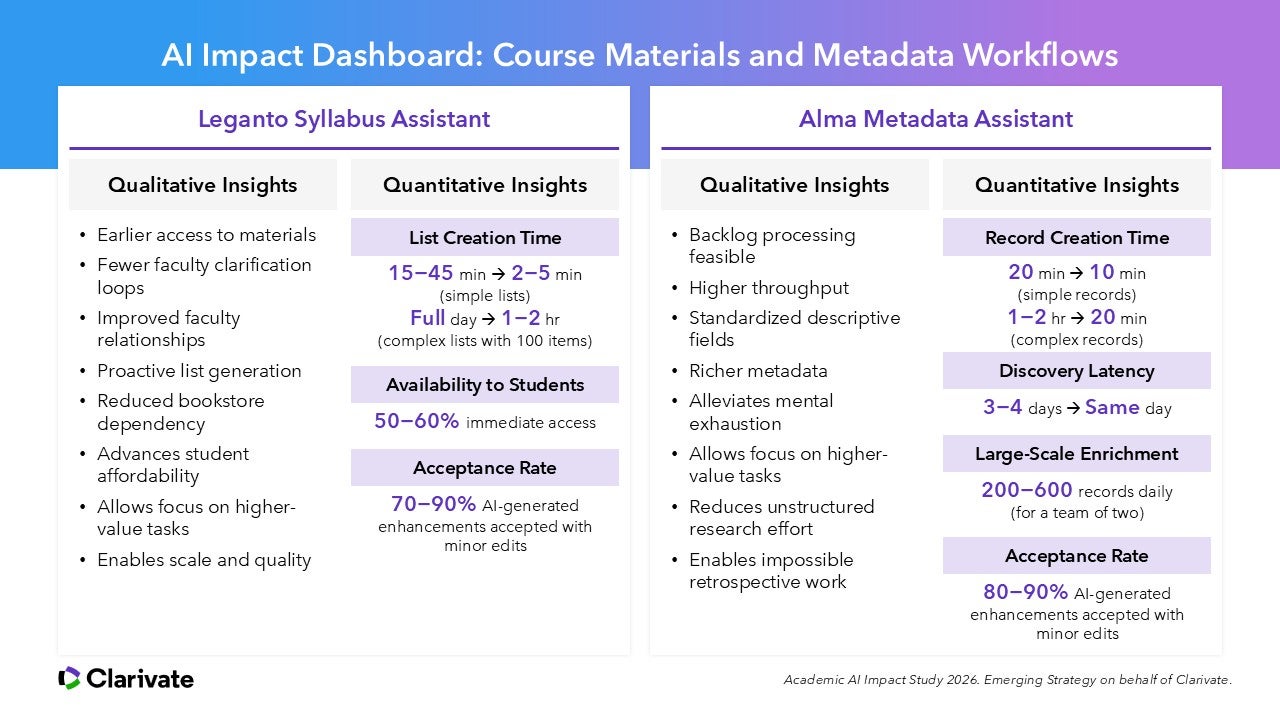
AI Impact Dashboard
See a snapshot of how AI tools are improving efficiency, consistency and throughput across course materials and metadata workflows.
Study methodology
The study is based on in-depth qualitative interviews with library professionals – 11 interviewees based in eight academic institutions, who use AI-powered tools in their daily workflows. Participants include R1 research universities, mid-sized comprehensive institutions and international universities with multilingual collections.
The study relied on self-reported time comparisons, volume metrics and workflow contrast analysis. Participants were asked to estimate:
- Time savings: How long specific tasks took before and after AI adoption (e.g., minutes per reading list, minutes per cataloging record).
- Volume metrics: How many courses, records or citations are processed in a typical week, month or term.
- Capacity indicators: Examples of new work enabled, backlog reductions achieved, or staff time reallocated to other responsibilities.
How to reference this study
We encourage you to reference this study where appropriate.
Recommended citation:
Emerging Strategy. (2026). Academic AI Impact: Measuring the Impact of AI Adoption on Academic Library Workflows. Commissioned by Clarivate.
Short citation for slides:
Academic AI Impact Study 2026, Emerging Strategy on behalf of Clarivate.
Looking ahead
As AI becomes more embedded in academic library operations, it is reshaping which tasks can be maintained, how quickly materials are delivered to users and where staff expertise is best directed. Libraries that take a thoughtful, well governed approach, one that complements professional judgment, are better equipped to handle ongoing demand, enhance access and stay responsive as standards, expectations and collaborative practices continue to shift across higher education.
Learn more about the study and understand the practical implications of AI-powered tools on academic libraries’ workflows.


