
Web of Science Research Intelligence and Web of Science Research Assistant integrate to help researchers identify opportunities and strengthen grant proposals.
In an environment defined by tighter budgets, increased competition, and growing administrative burden, institutions are under pressure to do more with less — while still improving research outcomes. Nowhere is this pressure felt more acutely than in the race for research funding. With unprecedented cuts to federal funding in the U.S., grant success rates declining in Europe, and rising costs threatening to outpace science and technology investment in Japan, helping researchers identify the right opportunities and win grants has become more urgent and more consequential.
For research office leaders and librarians, this challenge increasingly comes down to focus. A recent Research Professional News survey shows that securing and diversifying funding remain top institutional priorities, while researchers cite identifying suitable calls and winning grants as persistent challenges. Yet limited time, staffing, and resources constrain how much individualized support institutions can provide.
Researchers are already using AI tools such as Web of Science Research Assistant to accelerate literature discovery and review. By contrast, far fewer use AI to support funding discovery or proposal development — despite these being among the most resource-intensive and high-impact stages of the research lifecycle. This gap points to an opportunity to better support researchers as they decide which grants to apply for and how to position their research effectively.
Web of Science Research Intelligence: Designed for the funding challenge
Web of Science Research Intelligence is an AI-native platform that addresses both sides of this challenge: the growing difficulty of winning funding and the limited capacity of research offices to provide hands‑on support. Developed in partnership with the research community, it delivers advanced analytics to help institutions improve funding performance, optimize strategy, and demonstrate the societal impact of research. By embedding funding intelligence, analytics, and guided workflows into the research process, it helps researchers identify well‑matched opportunities and build clearer, more compelling cases for funding. At the same time, it allows institutions to extend consistent, high‑quality guidance at scale, without relying on one‑to‑one intervention.
Institutions that adopt Web of Science Research Intelligence gain access to the extended Research Assistant, an agentic AI workspace embedded within the Web of Science platform that connects discovery, funding intelligence, and analytics. Within this environment, researchers can identify relevant funding, explore and refine research topics, conduct rigorous literature reviews, and select the right journals for submission through guided, multi-step workflows that adapt to their goals over time.
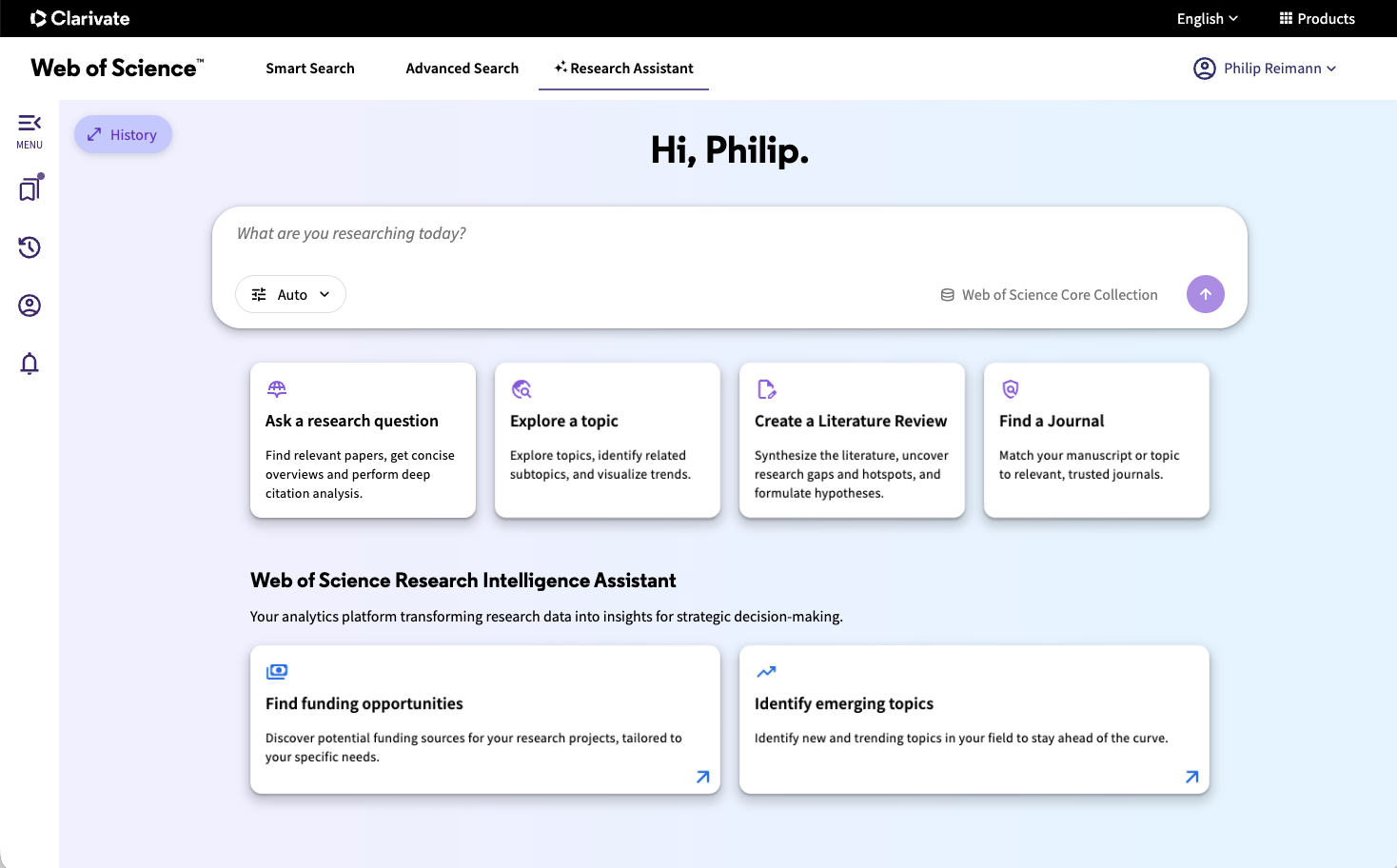
Figure 1 Extended Research Assistant on the Web of Science platform
The extended assistant pairs high-quality, authoritative data with responsible AI aligned to the research community’s expectations. Its insights are publisher-neutral, grounded in trusted, curated data, and fully transparent in provenance — supporting efficiency without compromising research integrity. Researchers can move seamlessly from discovery to funding identification to competitive positioning. This helps time-pressed teams craft stronger, evidence-based narratives that improve proposal quality and funding success.
Focusing on the right funding opportunities
Too often, researchers waste time pursuing low-probability calls. With the right context and intelligence, they can instead focus on opportunities where their work is most competitive or best aligned with a funder’s goals.
The extended assistant delivers opportunity discovery that goes far beyond keyword search. A funding discovery guide considers multiple signals, including a researcher’s topic, career stage, and location, to recommend funding calls that are a strong fit. It also surfaces the profiles of a program’s past awardees, along with the research those grants have supported. This gives researchers richer context as they decide where to invest their limited time and effort.
Positioning research within the state of the art
Grant reviewers may be assessing dozens of proposals, and they need to easily see the evidence, opportunities, and gaps that make a proposed project both timely and impactful. Competitive proposals are grounded in a sophisticated understanding of the current evidence base and the unmet scientific and societal needs a project addresses.
The literature review guide helps researchers define the research landscape . Drawing on high-quality publication and citation data, it highlights dominant approaches, emerging themes, and gaps in the literature. The emerging topics guide builds on this foundation. It helps researchers use agentic AI to clearly articulate how their work advances the field and establish a compelling case for novelty and relevance.
Building the right research team
Funders increasingly prioritize team science, particularly for translational programs. Building the right interdisciplinary team gives reviewers confidence that a project is feasible. Demonstrating the capability to execute shows that the necessary expertise is in place to deliver meaningful results.
Web of Science Research Intelligence helps researchers get the right domain expertise on the team through the expert finder guide. Researchers can find potential collaborators within and outside of their institution based on research output and impact in subdomains. Beyond locating co-investigators, the platform also helps researchers demonstrate that their work is embedded within a strong institutional environment. It maps publication strengths across departments to show institutional alignment, capacity, and readiness to deliver results.
Constructing a compelling impact narrative
In a highly competitive funding environment, reviewers rely on evidence of past performance and broader impact to assess where limited funding can deliver the greatest return. Researchers must clearly articulate their contributions, influence, and reach.
By bringing together authoritative evidence of scholarly contribution and indicators of real-world reach, Web of Science Research Intelligence enables researchers to build a stronger, more holistic narrative of success. Publications and normalized metrics help reviewers understand productivity and influence relative to discipline norms. Beyond academic influence, reviewers also look for signs of how research extends into policy, practice, and collaboration. Researchers can use Web of Science Research Intelligence to identify policy and patent citations, translational uptake, cross-disciplinary influence, and collaborative networks that show broader reach.
Paving the way for increased grant success
With the extended Research Assistant, Web of Science Research Intelligence delivers a cohesive, integrated experience that supports researchers from early topic exploration through funding discovery and proposal positioning. Librarians and research office leaders involved in its development see the platform as a way to more effectively connect researchers to both funding opportunities and collaborators that align with their expertise. This brings institutional insight into the research process at the moments when it can make the greatest difference.
By uniting authoritative data, funding intelligence, and responsible, AI‑powered guidance in one environment, Web of Science Research Intelligence helps researchers navigate an increasingly competitive funding landscape with clearer signals and stronger evidence. It empowers institutions to sustain ambitious research agendas and remain competitive in a funding landscape where focus and rigor make the difference.
Learn more about how the extended Research Assistant helps researchers move from ideas to stronger funding proposals.


Related insights
The latest news, technologies, and resources from our team.